

At some point, almost everyone who is stuck on a career decision has been told some version of the same thing: find your passion and follow it.
It sounds right. It sounds like the kind of advice that comes from a good place.
And for a very small number of people, it works — usually the ones who had a clear, strong interest from an early age that happened to map onto a viable career.
For everyone else, which includes most people, it produces a completely different outcome.
They spend months or years searching for a passion they can’t identify, feeling like something is wrong with them because the answer hasn’t arrived yet.
They take test after test, read book after book, and wait for the moment of revelation that never quite comes.
The problem isn’t them. The problem is the advice.
Starting a career search with passion is the wrong approach.
The more reliable, more practical, and — for most people — more successful starting point is your strengths.
Not what you love. What you’re genuinely good at.
This article explains why that distinction matters, how strengths-first career thinking works in practice, and how to use your natural abilities to identify career directions that are not only viable but genuinely satisfying.
–
–
The Problem With ‘Follow Your Passion’
The passion-first approach to career choice has been the dominant piece of career advice for decades. It’s also, for most people, the least useful one available.
Most People Don’t Have One Clear Passion
The first structural problem with passion-based career advice is that it assumes everyone has a single, identifiable passion that, once found, will point clearly toward a career.
The research doesn’t support this.
A study published in Psychological Science by researchers Gregory Walton and Paul O’Keefe found that people who hold a ‘fixed’ view of passion — the idea that you either have it or you don’t — are less likely to persist through difficulty, less interested in areas outside their passion, and less satisfied when their passionate interests run into real-world obstacles.
The concept of a fixed passion, the research suggests, sets people up for disappointment rather than fulfillment.
Many people have multiple genuine interests.
Some have interests that shift over time.
Some feel moderately engaged by several things but strongly pulled by none.
None of these are signs of a problem — they’re simply a description of most people’s actual experience, which doesn’t fit the passion narrative.
Passion Follows Competence—It Rarely Precedes It
This finding is perhaps the most important insight in career development research and the one most consistently ignored by conventional advice.
Cal Newport’s work, drawing on research by psychologist Amy Wrzesniewski and others, makes the case that passion for work is almost always the result of becoming genuinely good at something—not the cause.
You get good at something.
That competence creates real results for people.
Those results generate meaning and satisfaction.
The engagement deepens.
What looks like passion from the outside—a person deeply absorbed in their work, motivated and fulfilled—eventually starts from skill, not feelings.
The implication for career choice is significant: waiting to feel passionate before committing to a direction may mean waiting for something that can only arrive after you’ve started. Passion is more often a destination than a departure point.
‘Follow Your Passion’ Ignores Whether You’re Actually Good at It
Even when people have a clear passion, it alone doesn’t determine career suitability.
Someone who loves music but struggles to develop technical proficiency, someone who is passionate about medicine but finds the work environment consistently draining—passion without capability or fit produces frustration, not fulfillment.
A career that draws on genuine strength tends to produce engagement even through difficult periods, because the work itself feels manageable and the results feel real.
A career built on passion without corresponding strength tends to produce the opposite: repeated difficulty that erodes the original enthusiasm over time.
This is not an argument against caring about your work. It’s an argument for choosing a more reliable starting point than feeling alone.
–
–
Why Strengths Are a Better Starting Point
Starting a career search from your strengths rather than your passions produces a different kind of clarity—one grounded in evidence rather than feeling, and therefore more durable.
Strengths Are Observable — Passion Is Not
One of the practical advantages of starting from strengths is that they’re identifiable from evidence.
You don’t have to guess whether you have a strength—you can see it in patterns of behavior, in feedback from other people, in areas where you’ve improved quickly, and in work that produces results with less effort than it seems to take for others.
Passion, by contrast, is entirely internal and often unclear.
People regularly mistake interest for passion, confuse novelty with genuine engagement, or feel passionate about the idea of a career they’ve never actually tested.
Strengths provide you with something concrete to work with.
They’re the foundation on which everything else can be built.
Strengths Already Tell You Where You Can Compete
Gallup’s research across millions of workers consistently finds that people who use their strengths at work are more engaged, more productive, and more likely to report genuine satisfaction with their careers.
The effect is not small — employees who use their strengths daily are six times more likely to be engaged in their work.
This is relevant for career choice because engagement is what produces the outcomes people actually want from work: the sense that what they do matters, that they’re getting better at something real, that their effort produces results.
Strengths-based work generates these outcomes more reliably than passion-based work, because competence creates conditions for genuine engagement regardless of whether the work was initially exciting.
Strengths Are Transferable Across Industries
One of the most limiting beliefs people carry into career decisions is that their strengths are only relevant in their current field.
A teacher’s ability to explain complex ideas clearly. A project manager’s skill at holding competing priorities in order.
A salesperson’s capacity to read what someone needs before they’ve articulated it.
A writer’s ability to translate messy thinking into clear language.
These are not job-specific capabilities.
They cross industry lines, function across very different roles, and often become more valuable the more unusual their combination.
A strengths-first approach makes this transferability visible—opening career directions that a narrow, job-title-focused search would never surface.
| Strength Type | Where It Naturally Shows Up | Industries It Crosses Into | What It Produces |
| Clear communication | Teaching, writing, presenting, client work | Tech, healthcare, law, consulting, education | Explains complex things simply—valuable everywhere |
| Analytical thinking | Data, research, problem diagnosis | Finance, engineering, marketing, operations, science | Finds patterns others miss—increasingly in demand |
| Relational intelligence | Team leadership, sales, coaching, community | HR, social work, business development, management | Understands people — the skill most AI cannot replicate |
| Systematic organisation | Operations, project management, logistics | Healthcare, manufacturing, finance, events, tech | Makes things work reliably — needed in every sector |
| Creative problem-solving | Design, product, strategy, entrepreneurship | Advertising, startups, consulting, architecture, media | Generates new solutions — highest value in ambiguous situations |
–
Before you dive into the steps below, grab the free Starter Kit to start applying this as you go.
How to Identify Your Real Strengths (Not the Ones You Think You Should Have)
The most common mistake people make when assessing their strengths is listing what they’ve been trained in, what their job title suggests they should be good at, or what sounds impressive.
Those aren’t strengths — they’re credentials and assumptions.
Real strengths are different. They show up naturally, across different contexts, with less effort than the people around you seem to require. Here’s how to identify them reliably.
Question 1: What Do People Regularly Ask You For Help With — Outside of Work?
This is one of the cleanest signals of genuine strength available.
When people ask for your help with something outside your professional context—outside the role they know you in—they’re responding to an ability they’ve observed in you directly, not an assumption based on your job title.
A friend who always asks you to proofread their important emails.
A family member who calls you when something breaks and needs to be diagnosed. Colleagues from previous jobs who still reach out when they need to think through a complex problem.
These patterns reveal real capability.
Write down three things people come to you for outside of your professional context.
These are worth examining closely.
Question 2: Where Have You Improved Unusually Quickly?
Natural talent doesn’t mean effortless performance — it means you learn faster than the people around you.
Where have you picked things up faster than expected?
Where did the early, difficult stage of learning something new feel shorter for you than it seemed to for others?
Fast progress in a skill area is a reliable signal of underlying aptitude.
It doesn’t mean you’re already an expert—it means the foundation is there for expertise to be built on.
Question 3: What Work Produces a Flow State For You?
Research by psychologist Mihaly Csikszentmihalyi on flow — the state of deep absorption in a task where time seems to pass differently — consistently shows that flow occurs at the intersection of genuine challenge and genuine capability.
Flow occurs when you engage in activities that appropriately challenge you.
Flow happens in a specific zone: sufficiently challenging for the work to feel meaningful, sufficiently within your capability for progress to feel real.
The activities that reliably produce this state for you are pointing directly at your real strengths.
Not the work that feels pleasant and easy — the work that absorbs you even when it’s difficult.
Question 4: What Do You Find Yourself Doing Even When Nobody Asked?
Genuine strength often shows up as a pull toward certain kinds of thinking or activity, even in the absence of external motivation.
The person who reorganizes every system they come into contact with. The person who rewrites every communication they’re given because they can see how to make it clearer.
The person who always ends up facilitating when a group needs to work through a problem.
These spontaneous behaviors are important data.
They reveal abilities that are sufficiently developed to produce intrinsic motivation, meaning your brain finds the activity rewarding in itself without needing external incentives.
–
A useful exercise: Write your answers to all four questions above before reading further. Don’t edit as you go — just write honestly. Search for patterns across the answers. The strengths that appear across multiple questions are the ones most worth building a career around.
–
–
Turn Your Strengths Into a Clear Career Direction
Career Clarity in 7 Days walks you through the complete strengths-discovery process—with structured exercises for each step—and then connects your strengths to real career options through a day-by-day matching and elimination framework. The full system, in one practical workbook.
[Download it here → Career Clarity — Find Your Path in 7 Days
–
The Three Strength Categories and What They Point Toward
Once you’ve identified your natural strengths through the questions above, a useful next step is categorizing them.
Most professional strengths fall into three broad types, each of which points toward a different set of career directions.
Technical and Analytical Strengths
These are strengths centered on systems, data, logic, and problem-solving.
If you find yourself naturally drawn to understanding how things work, diagnosing problems, working with numbers or data, or building and optimizing processes—these are technical and analytical strengths.
Career directions that draw heavily on this strength type include data analysis, software development, financial planning, operations management, engineering, research, product management, and cybersecurity.
These fields are also among those with the strongest projected growth over the next decade, according to the BLS.
The World Economic Forum’s Future of Jobs Report identifies analytical thinking as the single most in-demand skill across industries through 2030.
If this is your primary strength category, you are well-positioned for a wide range of growing fields.
Creative and Expressive Strengths
These are strengths centered on communication, ideas, aesthetics, and making things.
If you naturally gravitate toward writing, designing, presenting, storytelling, or generating ideas that others haven’t considered, you have creative and expressive strengths.
Career directions that draw on this strength type include content creation, copywriting, brand design, UX and product design, marketing strategy, education and course creation, journalism, and social media.
These fields have expanded significantly with digital platforms and continue to offer diverse entry points for people with creative strengths.
An important clarification: creative strengths are not the exclusive territory of people with formal arts training.
Clear written communication, the ability to make complex things accessible, and skill in visual thinking all fall into this category—and all are consistently in demand across industries that would not describe themselves as ‘creative’ fields.
People and Relational Strengths
These are strengths centered on understanding, connecting with, influencing, and developing other people.
If you find yourself naturally skilled at reading what someone needs, building trust quickly, facilitating groups through difficult conversations, or helping others grow—these are people and relational strengths.
Career directions that draw on this strength type include coaching, counseling,
HR and talent development, sales, community management, teaching and training, social work, and management roles across virtually every industry.
These strengths are also among the most durable in an era of increasing automation. Research from the McKinsey Global Institute consistently identifies interpersonal skills, empathy, and the ability to understand and respond to human needs as among the capabilities least likely to be replicated by technology—making them an increasingly valuable foundation for careers.
From Strengths to Career Options: The Matching Process
Identifying your strengths is the starting point.
Turning them into a shortlist of viable career directions requires a structured matching process that connects what you’re naturally skilled at to what exists in the real world.
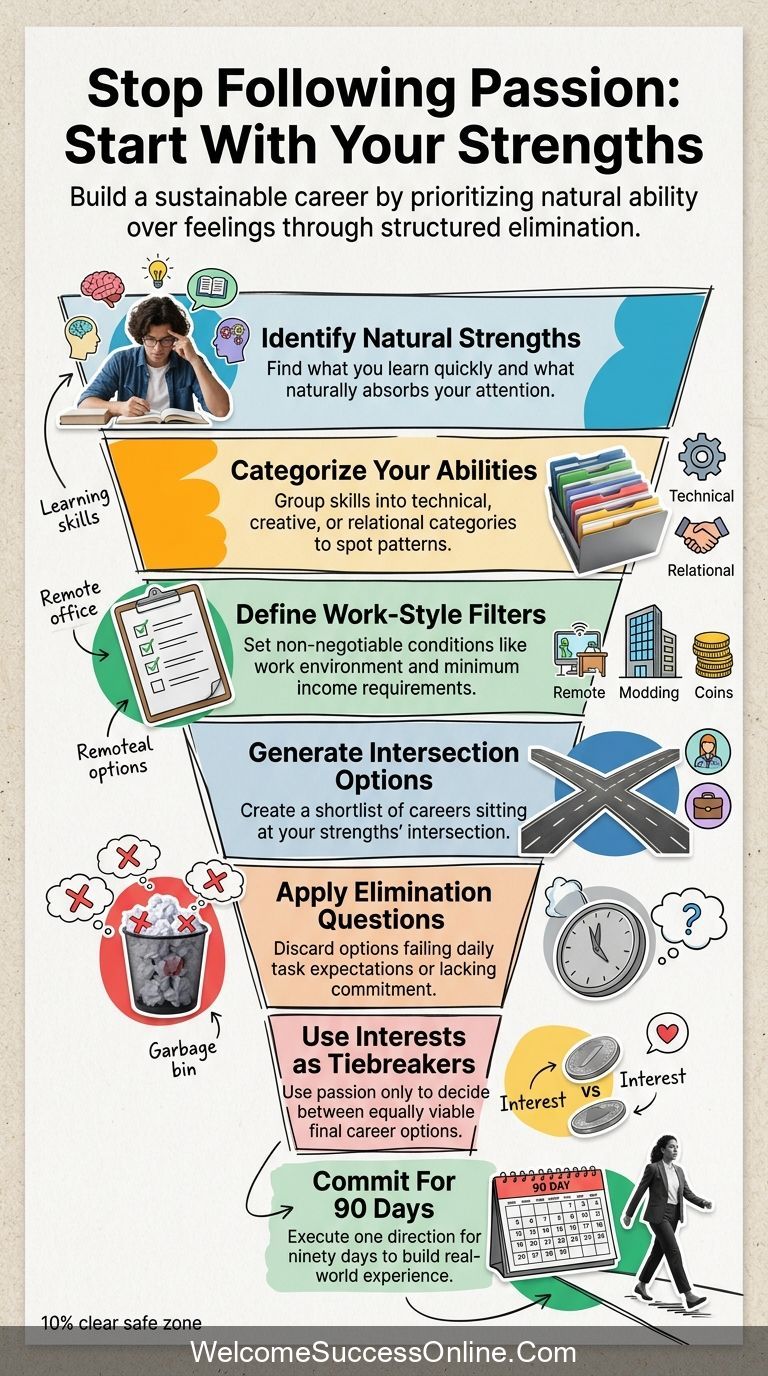
Step 1: Combine Strengths With Your Work Style Preferences
Strengths tell you what you’re capable of. Work style preferences tell you the conditions under which you can sustain that capability long-term. Both matter.
Before matching your strengths to career options, be specific about what you need from your working environment:
- Do you work best independently or in a team?
- Do you need clear structure and predictable processes or open-ended problems with room to figure things out?
- Do you need to see the direct impact of your work, or are you comfortable contributing to something larger without always seeing the results?
- What income floor removes financial stress from your life — not your ceiling, your floor?
- How much does work need to feel meaningful, rather than being a well-compensated means to fund other priorities?
Write your answers clearly. These become filters that eliminate career options automatically — saving you from pursuing directions that could use your strengths but would fail to meet your life requirements.
Step 2: Generate Career Options at the Intersection
Now ask: what careers sit at the intersection of my primary strengths and my work style requirements?
The goal at this stage is to generate a shortlist of three to five options. Don’t evaluate yet — just generate. Cast wider than feels comfortable.
Options that seem unlikely often become more viable once you know more about them.
One useful tool is the O*NET Interest Profiler (free, from the US Department of Labor), which maps your interests and strengths to specific occupations across hundreds of career categories.
The BLS Occupational Outlook Handbook gives you the practical data on each option — what the work actually involves, what it pays at different experience levels, and how much the field is projected to grow.
Step 3: Test Each Option Against the Elimination Questions
Once you have a shortlist, run each option through three specific questions before making any decision:
- Do I actually want to do the real daily work—not the idea of it?
- Imagine the actual tasks, the ordinary days, and the difficult moments. Does it still appeal?
- Does it genuinely meet my work style requirements? Not mostly — genuinely. Every non-negotiable should pass.
- Am I willing to invest 6–12 months learning and building in this direction before seeing significant results? A reluctant maybe is a no.
Any option that doesn’t pass all three gets eliminated.
What remains—usually one or two directions— is your genuine shortlist: options grounded in your real strengths, filtered by your real requirements, and tested against your real willingness to commit.
Step 4: Add Interests as a Tiebreaker — Not a Starting Point
Here is where interests and passions do have a legitimate role—as a tiebreaker between two options that have both passed the strengths and requirements filters.
If two directions both draw on your primary strengths and both fit your work style requirements, your level of genuine interest in each one is a sensible factor in choosing between them.
It just shouldn’t be the first question you ask—because at that point, it’s operating on a foundation of real capability rather than feeling alone.
The sequence matters: Strengths first. Requirements, second. Interests third. In that order, you build a career direction on a foundation that will sustain engagement through the difficult early stages—rather than one that depends entirely on the persistence of a feeling.
Making the Commitment: From Shortlist to Decision
The final step, after the matching and elimination process leaves you with one or two genuine directions, is to make a time-bounded commitment.
Not a permanent decision.
Not a life sentence. A 90-day commitment involves pursuing one direction with genuine effort—learning, practicing, and connecting—and seeing what the real experience reveals.
Research in behavioral psychology consistently shows that written, specific commitments produce markedly different behavior than mental intentions.
Please write your commitment down, sign it, and date it:
“For the next 90 days, I will focus on [specific career direction].” Then define what you will do in the first 48 hours. Not next week — within 48 hours. One course started. One message sent to someone in the field. One hour spent reading an industry publication. Small, specific, and immediate.
The 90-day commitment serves two purposes. It ends deliberation, which is the single most important thing it does.
And it generates the real-world experience that produces the kind of clarity no amount of thinking or research can deliver: the knowledge of what this work actually feels like when you’re inside it.
That experience is what passion-first advice promises and usually fails to deliver. Strengths-first career thinking earns it.
–
–
Frequently Asked Questions
What if my strengths don’t obviously point toward a specific career?
This scenario is more common than people expect, and it usually means one of two things.
Either your strengths haven’t been examined specifically enough—the questions in this article, worked through honestly, tend to surface more specific patterns than people initially expect—
Or your strengths are genuinely broad and transferable, which is not a problem but an advantage: it means you have a wider range of viable directions than someone with highly specialized skills.
In this case, the work-style requirements filter becomes especially important—it narrows the field where your strengths alone don’t.
Can I build a career on a strength I haven’t formally used in a professional context?
Yes — and this is one of the most underused insights in career development.
Strengths developed outside formal employment are just as real as those developed within it.
The person who is extraordinarily good at organizing information, explaining things clearly, or facilitating difficult conversations in a personal context has a genuine professional strength—regardless of what their CV currently shows.
The question is how to create evidence of that strength in a form that’s recognizable to employers or clients, which is what the 90-day practice phase is specifically designed to do.
What if I’ve been doing the same work for years and can’t tell what my actual strengths are anymore?
Long periods in a single role often make strengths invisible — you stop noticing what you’re good at because it feels routine.
The most effective way to break through this is external input: ask three or four people who have worked with you, or who know you well in any context, to describe what they think you do unusually well.
Their answers almost always surface patterns that feel obvious in retrospect but were genuinely invisible from inside.
Does this approach work if I’m a recent graduate with limited work experience?
Yes—and it often works better than more experienced career changers expect, because recent graduates haven’t yet convinced themselves that their strengths are limited to one industry.
The strength discovery questions in this article draw on behavioral patterns across all contexts—not just professional ones—which means they surface genuine capability regardless of how much formal experience someone has.
Academic work, part-time jobs, volunteering, projects, and personal interests all contain real evidence of strength.
What if I’m not sure whether something is a genuine strength or just something I’ve done a lot?
A useful distinction: something you’ve done a lot but find draining or difficult is a learned skill, not a natural strength.
A genuine strength is something that feels relatively effortless, improves quickly, and that other people notice and rely on, regardless of how much formal training is behind it.
If you’re uncertain, the flow state question tends to be the clearest indicator: do you experience genuine absorption in this work, even when it’s challenging?
If yes, that’s a strength. If the work feels like effort that depletes rather than engages you, it’s likely a learned skill rather than a natural one.
For a deeper dive, check out my guide on [I Don’t Know What Career to Choose: 7 Step Guide to Find Your Direction]
Your Strengths Are the Starting Point. The Guide Builds From There.
Career Clarity in 7 Days takes you through the complete strengths-discovery and career-matching process—day by day, exercise by exercise. By Day 4, you are shortlisted for career directions grounded in your real abilities. By Day 7, you have a committed direction and a 90-day action plan. Everything you need, in one practical workbook.
5 thoughts on “Don’t Know What Career Suits You? Start With Your Strengths (Not Your Passion)”
Comments are closed.