
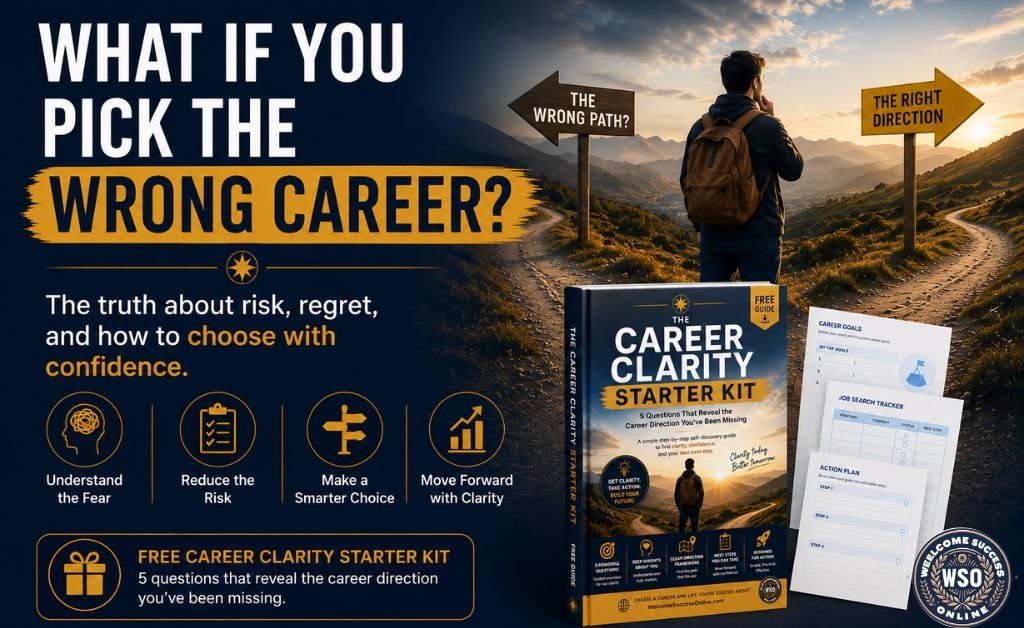
You’re close to a decision. Maybe you’ve already accepted an offer, enrolled in a course, or told people what you’re doing next.
And underneath it, one thought keeps looping: what if your choice is a mistake?
That fear is common, and it’s rarely about the career itself. It’s about what a wrong choice would cost you.
So let’s look at that cost honestly, because it’s almost always smaller than it feels in the moment—and there’s a practical way to shrink it further.
–
–
Why This Fear Feels So Big
Careers feel permanent in a way few other decisions do.
You don’t publicly announce most choices you make, but a career is visible—to family, to friends, and to your sense of identity.
That visibility raises the emotional stakes even when the practical stakes are lower than they feel.
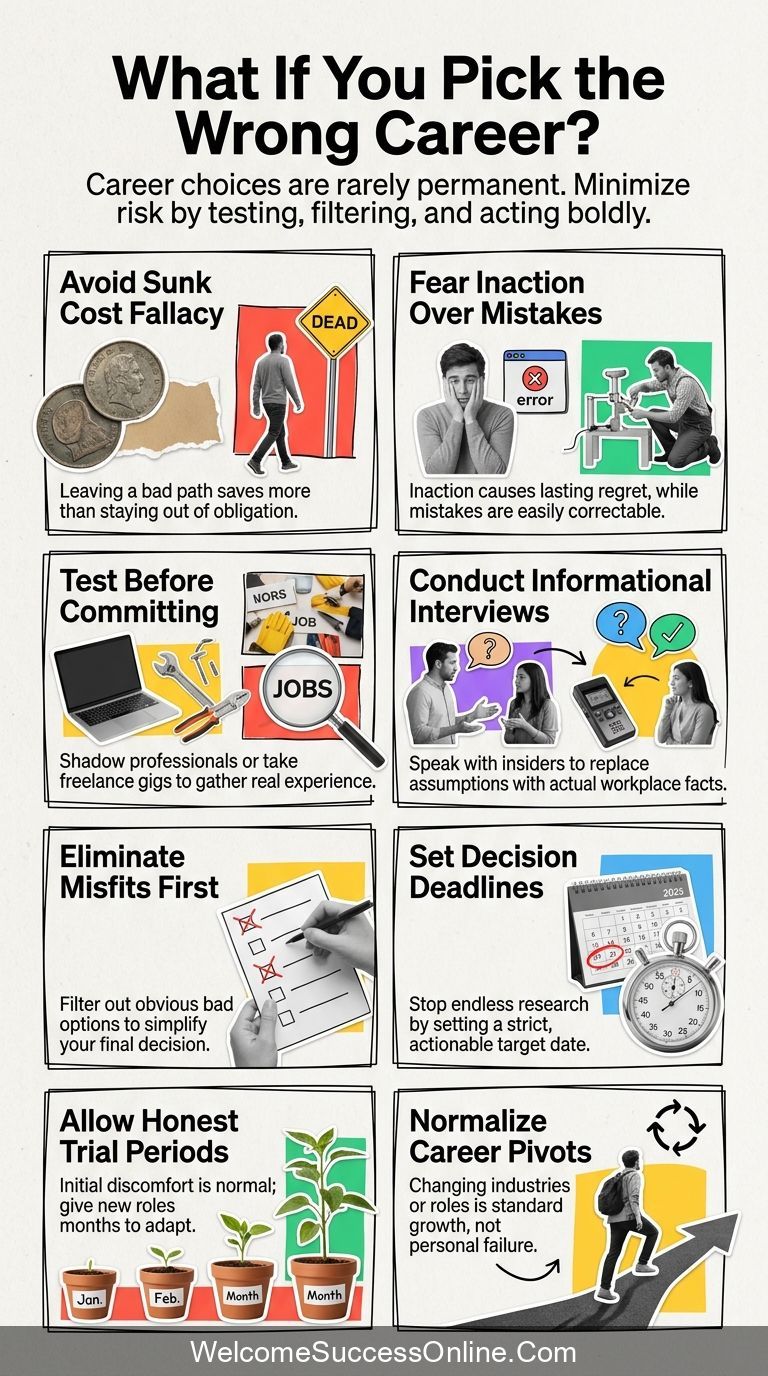
There’s also a specific trap at play: sunk-cost thinking.
Once you’ve invested time, money, or identity into a direction, walking away from it feels like admitting that investment was wasted—even when staying costs you more than leaving would.
The NIH’s Office of Intramural Training has a clear, practical breakdown of how the sunk cost fallacy shows up in career decisions—worth reading if you notice yourself thinking, “I’ve come this far; I can’t stop now.”
–

–
The Truth About “Wrong” Careers
Very few career choices are actually unrecoverable. Most people who choose a path that doesn’t fit end up adjusting within a few years—a different role, a different industry, or a different way of applying what they learned.
Pivoting isn’t a sign of failure. It’s closer to the norm than the exception.
There’s also research that should change how you’re weighing this decision.
Career researchers studying regret have found that people are far more likely to carry lasting regret over chances they didn’t take than over the ones they did—even when the ones they took didn’t work out.
A recent qualitative study in Career Development International found that taking action—even action that leads to a rough transition—tends to prevent the kind of lasting regret that comes from never trying at all.
| Reframe: The real risk isn’t choosing wrong. It’s staying stuck in indecision for years, which research suggests costs more long-term regret than a correctable mistake ever would. |
If this fear of choosing wrong feels familiar, the free Career Clarity Starter Kit is a low-pressure way to get a real first read on your direction before you second-guess yourself further.
How to Actually Reduce the Risk (Not Just Feel Better About It)
Reassurance only goes so far.
Here’s what actually lowers the odds of a costly misstep:
Run small, reversible tests before you commit fully
Shadowing someone in the role, taking on a small freelance project, or simply talking to people already working gives you real information before you’ve made an irreversible commitment.
This isn’t just intuition—a peer-reviewed study in the Career Development Quarterly found that structured informational interviews measurably increase people’s confidence and clarity around a career direction, precisely because they replace assumptions with firsthand information.
You can read the study here: Effectiveness of Informational Interviewing (Kanar, 2023)
Eliminate before you select
Instead of trying to find the single “right” answer, remove the options that clearly don’t fit first.
A shorter, filtered list is much easier to choose from confidently than a long list of unranked possibilities.
Set a decision deadline
Endless research doesn’t reduce risk past a certain point — it just delays the decision while adding more anxiety.
Give yourself a real deadline, based on the information you already have, rather than waiting for a certainty that isn’t coming.
–
–
What to Do If You Already Think You Chose Wrong
If you’re past the decision and now doubting it, the first question is whether this is genuinely the wrong path or just a rough, unfamiliar patch.
Almost every new direction feels uncomfortable for the first several months—that discomfort by itself isn’t proof of a mistake.
Give it a real, honest trial period before concluding anything.
If after that period the mismatch is still clear—not just uncomfortable, but wrong on the things that matter most to you (the work itself, the lifestyle, and the values)—that’s useful information, not a failure.
It’s exactly the kind of data that makes your next decision sharper.
Conclusion
Choosing a career path can be intimidating, and the fear of making the wrong choice is a common experience.
However, it’s important to acknowledge that most career decisions are not as permanent as they seem.
By understanding the nature of regret, embracing the possibility of pivoting, and employing practical strategies to reduce risk, you can navigate your career journey with confidence.
Remember, indecision often leads to greater regret than making a choice that you can adjust later. Take the time to explore your options, gather information, and trust the process.
Whether you’re just starting out or reevaluating your current path, the tools and insights shared here can empower you to make informed decisions that align with your values and aspirations.
Ultimately, your career is a journey of growth and discovery.
Embrace the twists and turns, and know that each step you take brings you closer to a fulfilling and meaningful professional life.
Frequently Asked Questions
1. What should I do if I feel uncertain about my career choice?
If you’re feeling uncertain, take a moment to reflect on your feelings. Consider seeking advice from mentors or professionals in your field.
Engaging in informational interviews can provide clarity and help you understand the realities of different roles. Remember, it’s okay to take your time to make a decision that feels right for you.
2. How can I effectively test a career path before fully committing?
You can test a career path by taking on internships, volunteering, or shadowing professionals in the field.
These experiences offer an understanding of the day-to-day responsibilities and culture of the job without requiring a long-term commitment. This approach can help you make a more informed decision.
3. What if I realize I’ve made the wrong career choice?
If you find yourself in a position that doesn’t align with your goals or values, assess the situation carefully.
Consider what aspects are not working for you and whether they can be adjusted. If not, remember that changing paths is a common experience and can lead to better opportunities that suit you more closely.
4. How can I reduce the anxiety associated with making a career decision?
To reduce anxiety, set a clear timeline for your decision-making process.
Break down your options into manageable steps and focus on gathering information rather than seeking absolute certainty.
Engaging in discussions with trusted friends or mentors can also provide support and perspective, helping to ease your worries.
–
| Turn This Into a Decision You Can Trust This is exactly what Day 5 of the Career Clarity Bundle: Find Your Path in 7 Days is built for — a structured process to eliminate the wrong paths before you commit, so the decision you land on is one you’ve actually pressure-tested, not just hoped would work out. – Download it here: Career Clarity—Find Your Path in 7 Days If you’re not there yet, start with the free Career Clarity Starter Kit—five questions that give you a real first read on your direction in a few minutes. |
4 thoughts on “What If You Pick the Wrong Career?”
Comments are closed.