

You’ve probably spent more time researching which phone to buy than you have deciding what to do with your career.
And yet, when it’s time to make that career decision, you freeze.
Not because you’re lazy.
Not because you lack ambition.
But because nobody ever taught you how to actually do this.
Most career advice you’ll find online sounds like it was written by someone who got their dream job at 22 and has never had to think about it since.
This guide isn’t that kind of article.
I’ve worked with people at all stages — recent graduates who feel paralyzed by options, mid-career professionals who’ve realized they’ve been climbing the wrong ladder, and people in their 30s and 40s who are starting over.
What do they all share?
They weren’t stuck because they lacked direction.
They were stuck because they were trying to solve the wrong problem.
This guide will change how you think about career decisions.
–
–
Why Choosing a Career Feels So Hard (It’s Not What You Think)
Before we get into the step-by-step process, it’s worth understanding why the decision feels so overwhelming in the first place.
The standard advice — “follow your passion” or “find your purpose” — sounds inspiring but is practically useless.
Most people don’t have a single burning passion that maps neatly onto a career.
And waiting to “discover yourself” before making a move is how you waste years.
Here’s what’s actually happening when you feel stuck:
You’re trying to make a permanent decision. You’re treating this like a one-time, irreversible choice, when in reality, careers are built through a series of small, adjustable decisions.
Research from the Bureau of Labor Statistics shows the average person holds 12 different jobs in their lifetime.
A career choice is not a life sentence.
You have too many options and no filter. When everything feels possible, nothing feels clear.
The problem isn’t that you don’t know what you want — it’s that you haven’t given yourself a structured way to eliminate what you don’t want.
You’re using thinking to escape action. Overthinking feels like progress, but it’s often avoidance dressed up as planning.
The more you think without doing, the more paralyzing it gets.
Understanding this changes the entire approach. You don’t need a revelation. You need a system.
Before you dive into the steps below — grab the free Starter Kit to start applying this as you go.
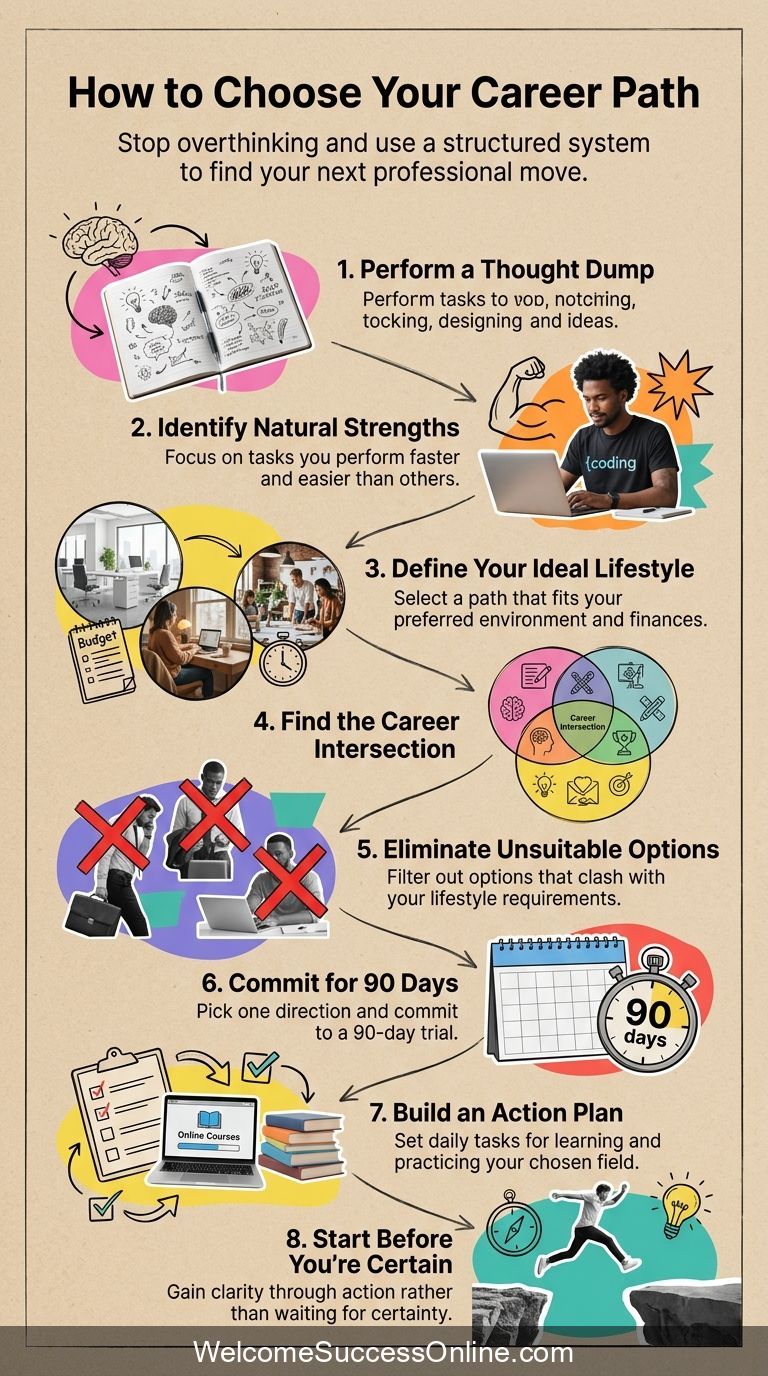
Step 1: Do a Full Thought Dump Before You Do Anything Else
The first thing I ask people to do isn’t take a personality test or research job markets. It’s to get everything out of their head.
Take a blank page and write down every career idea you’ve ever had—every job you’ve imagined yourself doing, every industry you’ve been curious about, and every skill you’ve thought about monetizing.
Include the ones that seem unrealistic.
Include the ones you abandoned years ago.
Include the “what if” ones you’ve never said out loud.
This isn’t a commitment list. It’s a clearing exercise.
When everything is swirling in your head, your brain is spending energy just trying to hold onto the thoughts.
Once it’s all on paper, you can start working with it. You’ll also notice patterns — things you keep coming back to that you’ve been dismissing.
Circle anything that still holds even a small amount of interest.
You’re not committing to anything.
You’re just giving yourself something to work with.
Step 2: Get Clear on What You’re Actually Good At
Most people confuse what they’re good at with what they’ve been trained to do.
These aren’t the same thing.
Ask yourself three questions: What do people regularly come to you for help with, even outside of work?
What tasks feel easier for you than they seem to for others?
Where have you improved quickly?
Areas where you picked things up faster than expected?
These questions reveal natural strengths. These are not qualifications on a resume, but the real abilities that show up across different areas of your life.
Write down your top five. Be honest.
If you’ve been in a job for a while, you’ve built skills that carry across industries—things like problem-solving, clear communication, organizing information, managing people, or explaining complex ideas.
These matters are more than most people realize when switching paths.
Don’t undervalue them just because they don’t have a fancy job title attached.
Step 3: Define the Life You Actually Want to Live
This is the step most career guides skip, and it’s the reason so many people end up in careers that look impressive on paper but feel wrong in practice.
Your career doesn’t exist in isolation.
It shapes when you wake up, who you spend your days with, how much control you have over your schedule, how much financial pressure you’re under, and how much energy you have left at the end of the day.
Be specific about what you want: Do you want to work remotely, in an office, or a mix of both?
Do you need financial stability, or are you comfortable with fluctuating income?
Do you work better alone or alongside a team?
Do you want to be the specialist, or do you prefer variety? How much do you want work to define your identity?
There are no right answers. But being honest here will eliminate a significant number of career paths — not because they’re bad, but because they don’t fit the life you’re trying to build.
Write one sentence: “My ideal work style is…” and fill it in.
This becomes a filter you’ll use in every step that follows.
Step 4: Match Your Strengths and Preferences to Real Career Options
Now you have three columns of information: what you’re good at, what genuinely interests you, and the kind of work environment that suits you.
The question to ask is, “What careers sit at the intersection of all three?”
This is where people often default to Google searches like “best careers for introverts” or “highest paying jobs without a degree.
“Those lists aren’t useless, but they’re generic. Your intersection is specific to you.
A more useful approach is to talk to people already doing work that touches on your strengths and interests.
Ask them what a regular week actually looks like — not the version on the company website, but the real one. Ask what surprised them about the role.
Ask what kind of person tends to struggle in it and what kind thrives.
Aim to identify three to five career paths worth exploring further. You’re not choosing yet—you’re building a shortlist.
Step 5: Eliminate Before You Decide
Most people try to choose the right option.
Fewer people think systematically about cutting the wrong ones.
Go through your shortlist and ask these questions for each option: Am I genuinely interested in the actual work or just attracted to the lifestyle, status, or income it represents?
Does it fit the work style I defined in Step 3?
Am I willing to spend the next six to twelve months learning and getting good at this job, even before I see significant results?
If an option doesn’t meet all three criteria, remove it. You should be left with one or two paths that pass the test. That’s not a limitation — that’s the point. Fewer options, more clarity.
Step 6: Make the Decision — and Write It Down
At some point, you have to stop thinking and start deciding.
Pick one path. Not forever. For the next 90 days.
Then write down three things about it:
Why this one over the others?
What genuinely excites you about it?
What concerns or fears do you have?
Writing down your fears matters.
They don’t disappear, but they become specific and addressable rather than vague and paralyzing.
A fear like “what if I’m not sufficiently competent enough?” is particularly challenging to work with.
A fear like “I don’t have experience in this field, and I’m worried employers won’t take me seriously” is something you can actually plan around.
End with this sentence, written out:
“For the next 90 days, I will focus on [career direction].”
That commitment — even if it’s only to 90 days — is more powerful than months of deliberation.
Step 7: Build a Realistic First Action Plan
Clarity without action is just a nice thought. This step is about moving.
Your plan doesn’t need to be complicated. It needs to be specific enough that you know what you’re doing tomorrow.
Break it into three phases—Learn: What do you need to understand about this field?
Identify two or three resources—courses, books, YouTube channels, or podcasts—and start one this week. Not next week. This week.
Practice: What’s the smallest possible version of this work you can start doing now? If you’re interested in writing, just start writing.
If you’re interested in design, start designing — even if it’s not very good Real practice tells you more than any amount of research.
Apply: What does entry into this field look like? Jobs, freelance projects, internships, side work — find out what people actually do to get started, then start doing those things.
For each phase, answer: what will I do this week, and what will I do tomorrow? Keep the plan small enough that it’s actually doable.
A plan you actually follow is better than a perfect plan that stays on paper.
–
–
The Most Common Mistakes That Keep People Stuck
- Waiting for certainty before starting. Certainty comes after action, not before. You learn more about whether a career is right for you in three months of actual work in the field than in three years of thinking about it.
- Trying to find a career that feels 100% right immediately. Most meaningful careers feel awkward and uncomfortable at the beginning. That discomfort isn’t a signal to stop — it’s a signal that you’re learning.
- Letting other people’s timelines determine your urgency is a mistake. Someone else finding their direction at 22 doesn’t mean you’re behind. Your path is measured against your progress, not anyone else’s.
- Mistaking research for progress. Reading about careers, watching videos, talking about careers — none of these activities is the same as testing them. At some point, you have to step into the work and see what it actually feels like.
What to Do When You’re Still Not Sure
If you’ve genuinely worked through this process and still feel uncertain, that’s okay — and it’s more common than people admit.
Choose the option that feels most interesting to you right now and give it 90 days of focused attention. Not half-hearted attention. Real, consistent attention.
By then, you’ll know much more about whether it’s right for you than you do now.
Career clarity isn’t something that arrives fully formed.
It builds through honest self-reflection, small decisions, and actual experience. You don’t need to see the whole staircase.
You just need to take the next step.
Frequently Asked Questions
What if I’m interested in more than one career?
That’s normal, and it’s not a problem — it’s actually a good sign. The exercise in Step 5 is designed specifically for those situations.
Work through the elimination questions honestly and see what survives. If two options still feel genuinely equal after that, pick one and try it for 90 days.
You can revisit the other one. You cannot try both at full commitment simultaneously.
How do I choose a career if I have no experience?
Start with your transferable skills (Step 2) and your genuine interests, not with what you’re “qualified” for on paper.
Many career paths are more accessible to people without direct experience than job postings suggest — especially if you’re willing to start at a junior level, take on freelance work, or build a small portfolio of your own.
What if I choose wrong?
You likely will—at least once. Most people do. A wrong choice isn’t a failure; it’s information. It tells you something real about what does and doesn’t suit you.
And a wrong choice you can course-correct from is always better than the paralysis of making no choice at all.
Is it too late to change careers?
Almost certainly not!
Career transitions happen at every age, and skills built in one field transfer to others more than most people expect.
The harder question isn’t whether it’s too late—it’s whether you’re willing to be a beginner again.
That’s uncomfortable, but it’s also temporary.
For a deeper dive, check out my guide on [I Don’t Know What Career to Choose: 7 Step Guide to Find Your Direction]
Ready to Go Deeper?
If this resonated with you, the next step is to go through this process yourself — not just read about it.
The Career Clarity — Find Your Path in 7 Days guide walks you through each of these steps with structured exercises designed to get you from confusion to a clear decision.
2 thoughts on “How to Choose a Career Path When You Have No Idea Where to Start”
Comments are closed.