
Most career advice tells you to find the one thing you’re meant to do.
That’s a lot of pressure to put on a single decision—and it’s also not really how enjoyable careers tend to get built.
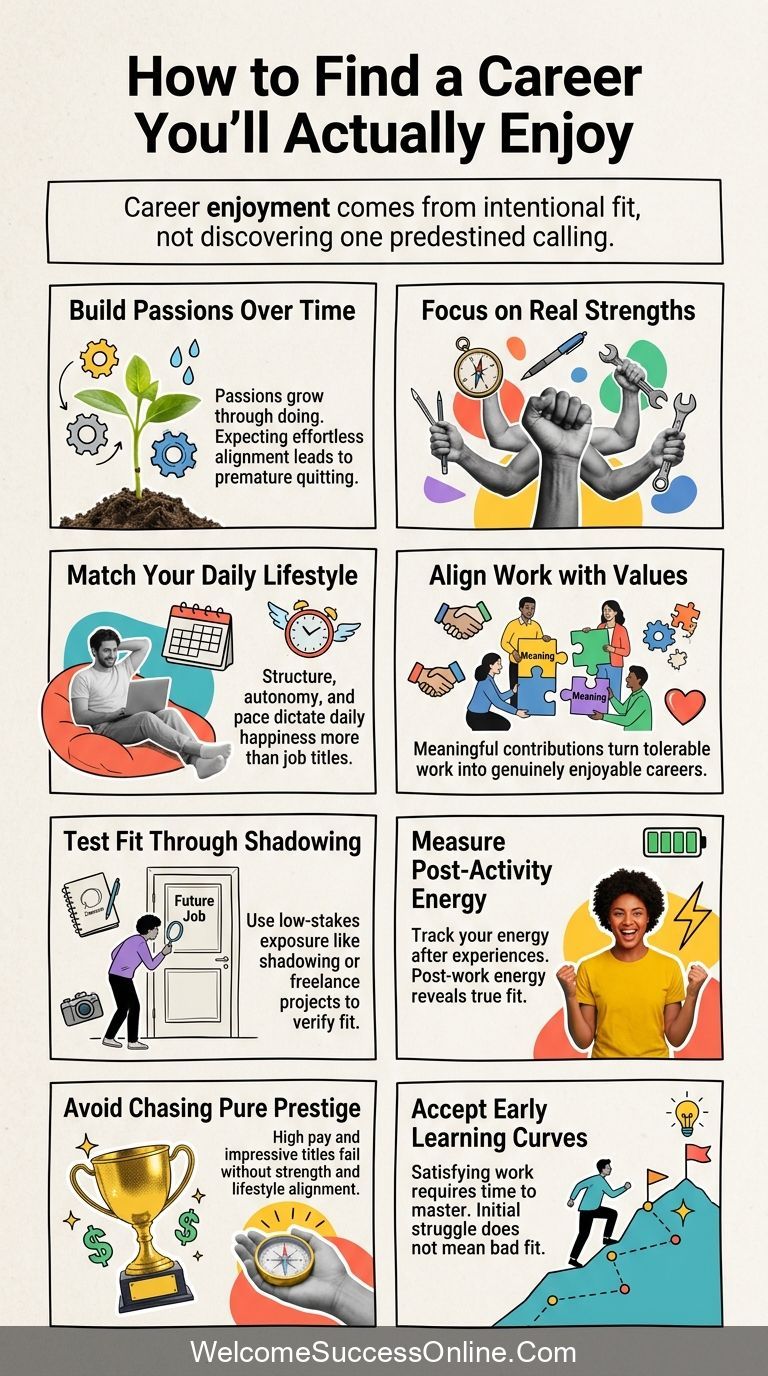
Enjoyment comes from fit: your strengths, your lifestyle, and what the work actually contributes to.
Most people could genuinely enjoy more than one path—the goal isn’t finding the one true match; it’s finding a good fit and building from there.
–
–
Why “Follow Your Passion” Falls Short
The idea that passion is something you discover, fully formed, before you commit to it sounds appealing—but it sets people up to quit the moment things get difficult.
If interest is supposed to feel effortless, then the first real challenge feels like proof you picked the wrong thing.
Stanford researchers tested this directly: students who believed passions are fixed and waiting to be found lost interest fast once material got difficult, while those who believed interests develop over time stayed engaged. You can read Stanford’s full write-up of the study here.
The practical takeaway: most people have more than one path they could genuinely enjoy.
The goal is a good fit, not a single predestined calling.
The 3 Ingredients of a Career You’ll Enjoy
Strengths — what comes easily and produces good results
Not just what you enjoy, but what you’re actually good at.
The two aren’t always the same, and confusing them is one of the most common reasons people end up in work that looks appealing but never quite feels satisfying.
Gallup’s research backs this up clearly: people who use their strengths every day are three times more likely to report an excellent quality of life and six times more likely to be engaged at work
Lifestyle fit—pace, structure, people contact, and autonomy
A job title tells you almost nothing about your actual day-to-day life inside it. Remote or in-office, structured or flexible, high-income or low-stress, solo work or constant collaboration—these preferences shape your daily experience as much as the work itself.
Values alignment — what the work actually contributes to or protects
Work that conflicts with what you genuinely care about tends to feel hollow even when it pays well and uses your strengths.
This one is easy to skip because it’s harder to test than the other two—but it’s usually what separates “tolerable” from “actually enjoyable.”
| Reflection Prompt Think of the last time work felt genuinely good, even briefly. What were you doing, and which of the three ingredients above was present? |
–
–
How to Actually Test Fit Before Committing
You don’t have to guess. Small, low-stakes exposure to a field tells you more than any amount of research from the outside.
Job shadowing is one of the most direct ways to do this.
Research grounded in Holland’s theory of vocational choice shows that people are more satisfied and successful when their work environment matches their personality and preferences, and shadowing lets you test that fit in practice before committing. You can read more on this research here.
Beyond shadowing, informational interviews, small freelance projects, or volunteer work in a field all serve the same purpose — replacing assumptions with real information.
Pay attention to your energy after these experiences, not just your interest before them.
Interest is easy to fake to yourself; energy afterward is harder to.
Common Traps That Keep People From Enjoyable Work
A few patterns worth watching for as you go through this process:
Chasing prestige or salary alone, without checking fit against your strengths or lifestyle.
Picking something because it’s impressive to explain at a party, rather than because the daily reality of it appeals to you.
And avoiding anything that requires a learning curve — which rules out almost everything worth doing, since nearly all satisfying work takes time to feel easy.
If you’re ready to find work that actually fits, the free Career Clarity Starter Kit is a fast way to surface your strengths and lifestyle preferences in just a few minutes.
Conclusion
A career you’ll actually enjoy isn’t the result of finally identifying your one true calling—it’s the result of a good fit between your strengths, your lifestyle, and what the work actually contributes to.
Most people could genuinely enjoy more than one path, which takes a surprising amount of pressure off any single decision.
The mistake isn’t picking wrong. It’s skipping the fit check entirely—chasing prestige or salary without asking whether the daily reality actually suits you or waiting for passion to arrive before you’ve given anything a real chance to develop.
Small, low-stakes exposure — shadowing, informational interviews, a short freelance project — tells you more about fit than any amount of thinking about it in the abstract ever will.
Test before you commit, and pay attention to how you feel afterward, not just how appealing it sounds beforehand.
Frequently Asked Questions
1. What if I enjoy several different career paths equally?
That’s normal, and it’s actually a good position to be in.
Use the three ingredients—strengths, lifestyle fit, and values alignment—to compare your options side by side, then let real-world testing (shadowing, informational interviews) act as the tiebreaker.
2. Can I enjoy a career I’m not naturally good at yet?
Early-stage struggle is normal and doesn’t necessarily mean poor fit—most satisfying work takes time to feel easy.
The distinction worth watching is whether your energy after doing the work trends upward over time, even while the skill itself is still developing.
3. How is this different from “follow your passion”?
“Follow your passion” assumes you already know what you love before you start.
This approach assumes the opposite — that fit and enjoyment often develop through doing the work, not before it, which matches how interest actually tends to grow according to the Stanford research cited above.
4. What’s the single fastest way to test whether a career is a good fit?
Job shadowing or a short informational interview.
Both give you real information from direct exposure in a matter of hours, compared to weeks or months of research from the outside.
–
| Ready to Build a Career You Actually Enjoy? Days 2 and 3 of the Career Clarity Bundle: Find Your Path in 7 Days map directly onto the three ingredients covered here—strengths, lifestyle fit, and elimination—giving you a structured way to find real fit, not just another list of options. – Download it here: Career Clarity — Find Your Path in 7 Days If you’re not there yet, start with the free Career Clarity Starter Kit — five questions that give you a real first read on your direction in a few minutes. |
2 thoughts on “How to Find a Career You’ll Actually Enjoy”
Comments are closed.