

Ever feel like you’re running in place, trying to chase down your dreams?
You’re not alone. Checkout the Reverse Goal Setting Method!
I was in a similar situation until I discovered the concept of backward goal-setting, which revolutionised the process of mapping out success incrementally.
This article is going to break it all down for you, transforming those lofty goals into manageable actions.
Get ready to see things more clearly and start checking off those achievements!
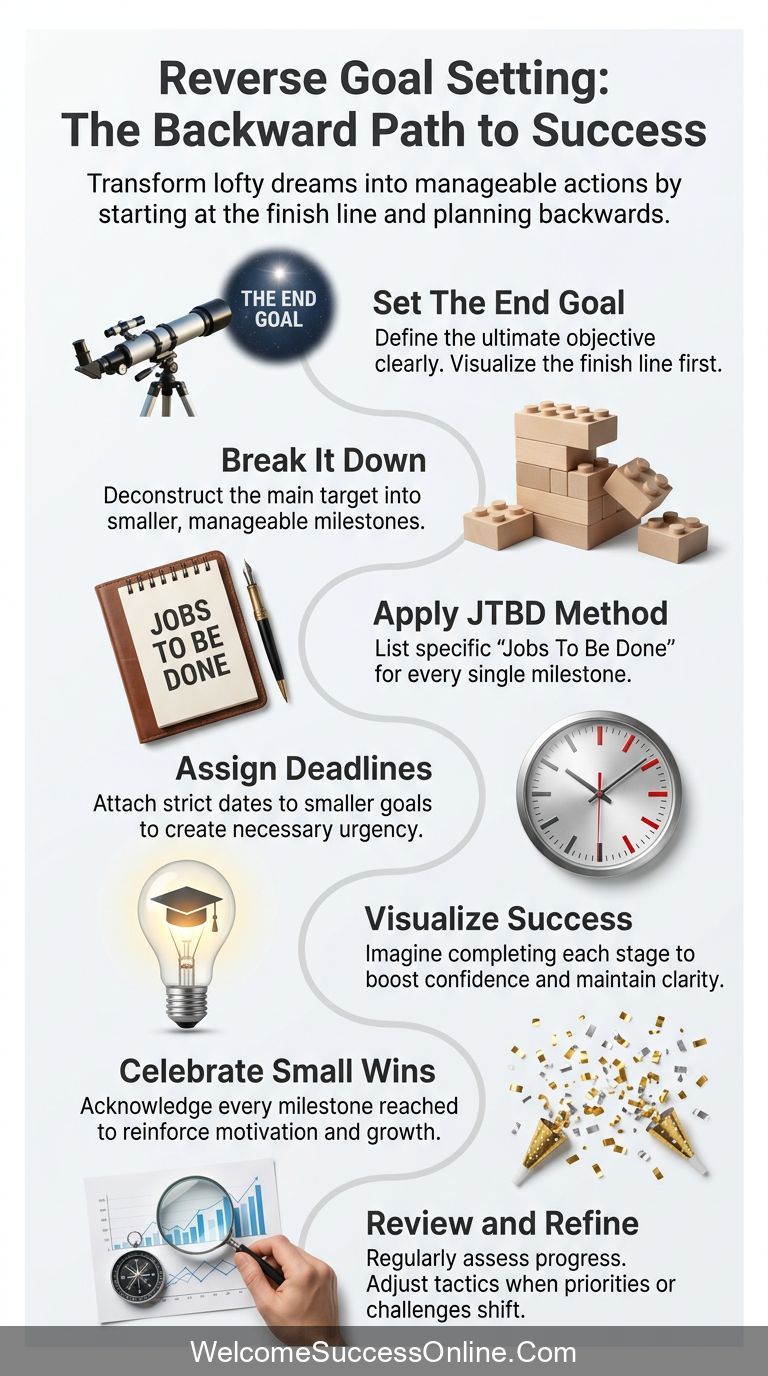
Key Takeaways
- Start with the end goal and break it down into smaller steps. This makes your big goal feel more achievable.
- Use the Jobs To Be Done (JTBD) method to list specific tasks for each small goal. It helps to focus on what’s important.
- Celebrate small wins to stay motivated. Each milestone reached is a step closer to your final target.
- Continue reviewing and adjusting your goals as needed. This keeps you on track even when things change.
- Visualising success at each stage boosts confidence and clarity, making it easier to achieve your goals.
Steps for Using the Backward Goal-Setting Technique
To use the backward goal-setting technique, I first start with my end goal.
Next, I break it down into smaller steps that lead me there.
Each step makes my plan easier to follow and helps me stay on track.
Set an end goal
I start by setting an end goal. This is the ultimate objective I want to achieve.
Having a clear end goal gives me direction. It helps me know where I need to go.
Visualising my end goal makes it feel real. I think about what it looks like when I achieve it.
This visualisation keeps me motivated and focused on my path.
By defining this main target, I can then break down my end goal into smaller milestones and steps that lead there.
The key to success is having clarity about your goals.
Break down the goal into smaller goals
After I set my end goal, it’s time to break it down into smaller goals.
Smaller goals make the path clearer and easier to follow.
- Identify key milestones. I think about what major steps I need to take along the way. Each milestone represents a mini-goal that brings me closer to my final target.
- Create action steps for each milestone. Under each milestone, I list specific tasks I need to complete. These tasks are also known as “Jobs To Be Done,” or JTBD, which help me understand what needs focus.
- Set deadlines for these smaller goals. Assigning a date makes me accountable. It creates urgency and keeps my motivation high.
- Visualise success with each small goal achieved. Imagining myself completing these steps helps me feel more confident in reaching my end goal.
- Review and refine my small goals regularly. As I progress, some tasks may change or new ones might emerge, such as shifting priorities or unexpected challenges that require me to reassess my approach. Adjusting helps ensure I stay on track and adapt if needed.
- Celebrate small wins along the way. Every time I reach one of these smaller goals, I take a moment to celebrate my progress. This boosts my motivation and reinforces my growth mindset.
Breaking down my end goal this way feels less overwhelming and promotes productivity in achieving success through backward planning.
Structure your plan with JTBD (Jobs To Be Done)
To organize my plan using JTBD, I begin by outlining the essential tasks that require completion.
This method helps me clarify what I want to achieve.
For each smaller goal, I think of the specific jobs or actions required to reach my end goal.
Each job becomes a step in my overall plan.
Using JTBD (Jobs To Be Done) helps me focus on what matters most.
It ensures that all steps are clear and relevant.
As I break down my end goal into manageable parts, it becomes easier for me to see how everything fits together.
This clarity boosts my motivation and simplifies planning for success.
Now, let’s look at the benefits of backward goal-setting next.
Benefits of Backward Goal-Setting
Backward goal-setting has clear benefits.
It gives me a better view of my goals and helps me act fast to reach them.
Clarity
Clarity is key for success. I find that knowing my end goal helps me stay focused.
With backward goal-setting, I start with what I want to achieve and work backwards.
This gives me a clear picture of the steps ahead.
It’s easier to break down my end goal into smaller milestones.
Visualising my future success feels real when I use this method.
I can see where I’m going and what it takes to get there.
By refining each step, planning becomes concrete.
This clarity cuts through confusion, making it simpler for me to reach my goals in personal development and self-improvement.
Urgency
Urgency is a big part of backward goal-setting.
It pushes me to take action now. I see my end goal as something I have already achieved.
This vision gives me motivation and excitement.
I know what steps I need to take in reverse order.
Setting smaller milestones helps create a clear plan.
Each milestone has its deadline, which adds pressure to succeed.
Without urgency, it’s easy to put off tasks and lose focus on my goals.
Backward planning makes me think critically about the necessary steps for success while keeping that sense of urgency alive in my daily actions.
Concrete planning
Concrete planning is key to achieving my goals.
I start with my end goal in mind. This helps me see what I want to accomplish clearly.
From there, I break down my main goal into smaller steps.
Each step feels more manageable and less overwhelming.
By using the backward goal-setting technique, I can create a solid plan.
This method allows me to visualise my success as if it has already happened. It makes the journey feel real and achievable.
Reverse engineering the necessary steps helps refine each part of my plan for better focus on self-improvement and success in goal setting, which includes identifying specific milestones and actionable tasks that contribute to achieving my ultimate goals.
Conclusion
Using the backward goal-setting technique can lead to success.
I start with my end goal in mind and then break it down into smaller steps.
This method gives me clarity and helps me visualize my future.
It makes planning easier and more focused.
By following these steps, I can stay on track and reach my goals more effectively.
FAQs
1. What is the backward goal-setting technique for success?
The backward goal-setting technique for success is a strategy where you start with your end goal and break it down into smaller, manageable steps.
2. How do I use the reverse goal-setting method?
To use the reverse goal-setting method, begin by visualising your end goal. Next, refine your goals and then break them down into smaller tasks. Finally, reverse-engineer the necessary steps to reach each task.
3. Can this step-by-step plan help in self-improvement?
Yes! This step-by-step plan of using backwards or reverse engineering in setting goals can be an effective strategy for self-improvement, as it provides clarity on what needs to be accomplished.
4. Why should I visualise my end goal when using this technique?
Visualising your end goal helps refine it and makes it easier to break down into achievable tasks, making this strategy more successful.