

Wanting to change career direction is one thing.
Not knowing where to begin is another problem entirely — and it’s the one that keeps most people stuck far longer than necessary.
The blank slate creates paralysis. When you’re unhappy where you are but have no clear idea where you want to go, even the first step feels impossible.
You can only research options you have identified.
You can’t plan a transition when you don’t know the destination. You can’t build momentum toward something that’s still undefined.
What most people do at this point is wait.
They wait for an idea to arrive, for someone to suggest something, for a moment of inspiration that finally makes the path obvious.
Some people wait for years.
The problem with waiting is that career clarity doesn’t come from it.
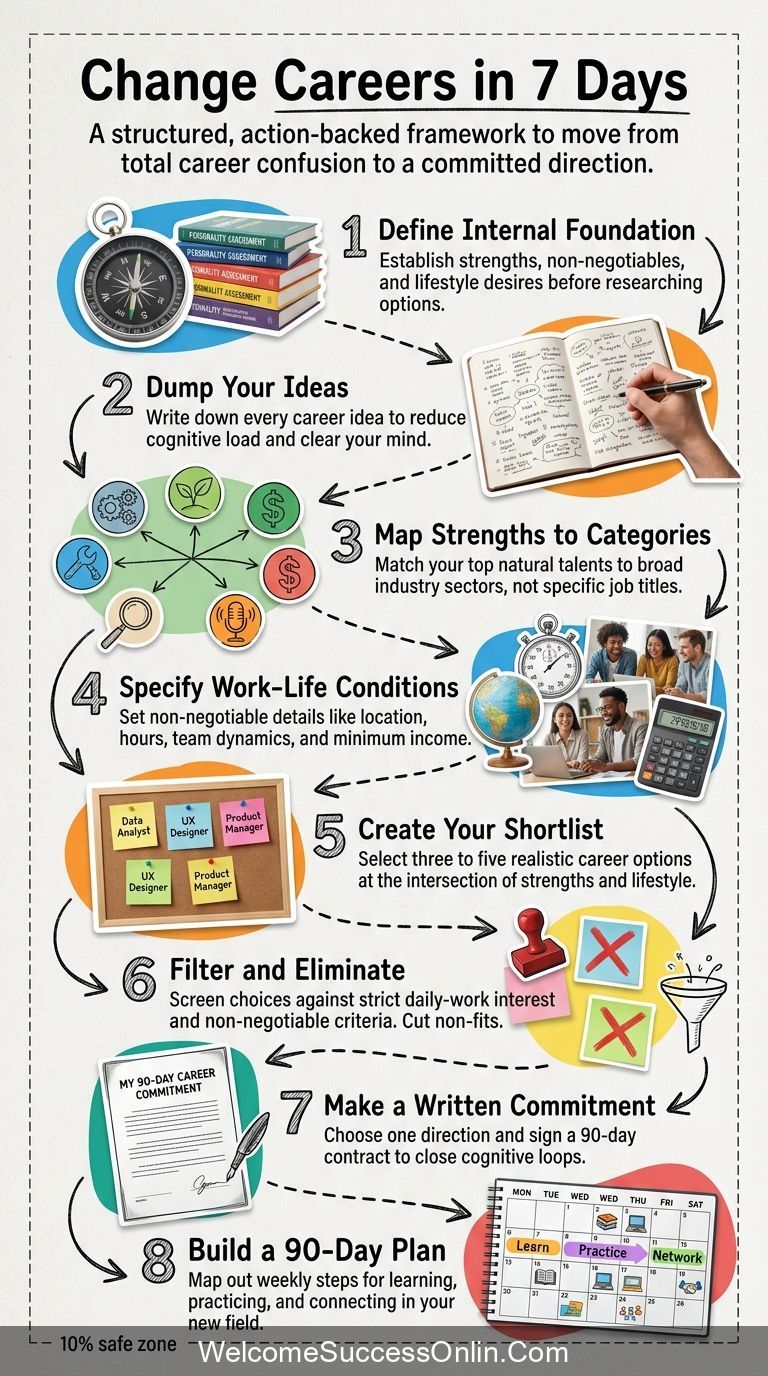
It comes from a specific sequence of structured actions—each one building on the last—that take you from a blank slate to a committed direction faster than most people expect is possible.
This article walks you through that sequence.
It’s the same framework behind the 7-day system that has helped people across different industries, life stages, and starting points get from confusion to a clear, committed career direction—often within a week.
–
–
Why ‘I Don’t Know Where to Start’ Is a Solvable Problem
The feeling of not knowing where to start with a career change sounds like a knowledge problem. In reality, it’s almost always a process problem.
You’re not missing information that would suddenly make everything clear.
You’re missing a structured sequence that takes the information you already have—about yourself, your preferences, and what you’ve responded to in work before—and turns it into a usable direction.
Here’s an important distinction that changes how you approach this:
| The Problem Type | What It Looks Like | What It Actually Needs |
| Knowledge problem | “I haven’t researched enough options yet.” | More research, informational interviews, and industry exploration |
| Process problem | “I have ideas but can’t turn them into a decision.” | A structured framework to filter, match, and commit |
| Fear problem | “I know what I want, but it feels too risky.” | Risk assessment, small experiments, and a time-bounded commitment |
| Clarity problem | “Nothing feels right, so I don’t know where to go.” | Strengths-first approach: build from what you know, not what you want |
Most people experiencing a career change from a blank slate are dealing with a process problem or a clarity problem—sometimes both.
Neither of these requires waiting.
Both are solvable with the right starting point.
The Right Starting Point (It’s Not What Most People Think)
When people decide to change their career direction, their instinct is usually to start by researching career options.
They look at job listings, read about different industries, take online assessments, and try to find something that appeals.
That approach has a structural problem: you’re trying to evaluate options before you’ve established the criteria for evaluation.
Without knowing what you’re looking for—specifically—you have no reliable way to assess whether something is right for you.
The right starting point is always internal, not external.
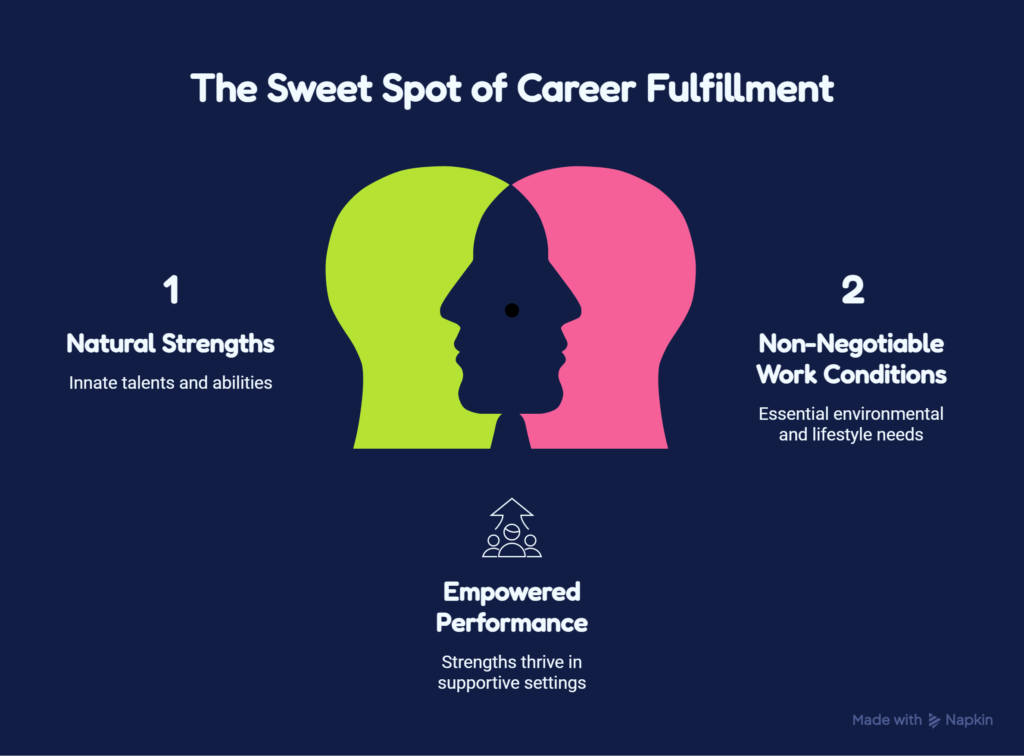
Before researching a single career option, you need three things clearly defined:
1. Your Natural Strengths — Not Your Qualifications
Qualifications are what you’ve been trained in.
Strengths are what you’re naturally capable of — abilities that show up across different contexts, that other people notice and rely on, and that feel easier for you than they do for others.
These are not the same, and confusing them is a common reason people end up in careers that don’t fit.
A qualification can take you into a field. A strength is what determines whether you’ll actually thrive there.
Three questions that reliably surface real strengths:
What do people regularly ask for your help with, even outside a professional context?
What tasks feel noticeably easier for you than they do for the people around you? Where have you improved quickly?
Areas where the learning curve was shorter than expected?
Gallup’s research on strengths-based development consistently finds that people who build careers around their natural strengths report significantly higher engagement and performance than those who don’t.
Starting here isn’t idealistic — it’s practical.
2. Your Non-Negotiable Work Conditions
Everyone has conditions that, if violated, make them miserable, no matter how interesting the work or how well it pays.
These are your non-negotiables.
They might include things like needing genuine autonomy over your time, requiring work that connects to something meaningful, needing a certain minimum income to remove financial stress, or needing to work independently rather than in a highly collaborative environment.
Defining these before you research options means you’re filtering from the start—which eliminates the problem of evaluating dozens of options that were never going to work for you.
3. The Lifestyle Your Career Needs to Support
A career isn’t just a job. It’s a daily structure that determines what time you wake up, how much of your energy it takes, how much flexibility you have, and how much of your identity it occupies.
Two people with the same job title can have entirely different experiences depending on the company, the role’s scope, and the industry’s demands.
Being specific about the lifestyle you’re building toward—not vaguely, but in concrete terms—gives you a filter that automatically eliminates many options.
Write one sentence before you research anything: “My ideal work life looks like “this”—and fill it in specifically. Remote or office? Solo or team? Structured or open-ended? High-income priority or low-stress priority? The more specific you are, the more useful this sentence becomes as a filter.
—
Before you dive into the steps below — grab the free Starter Kit to start applying this as you go.
Phase 1 of the Career Change Method: Discover (Days 1–2)
With your internal foundation established, the first phase of a structured career change is discovery — specifically, the kind that generates real options rather than just more confusion.
Day 1: The Everything Dump
Before evaluating anything, write down everything that comes to mind.
Write down every career idea you have ever seriously considered—including the ones that seem unrealistic, the ones you abandoned years ago, and the ones you’ve never admitted to anyone.
This is not a commitment list. It’s a clearing exercise.
When options exist only in your head, your brain holds them simultaneously, creating an overwhelming feeling that makes starting impossible.
Externalizing them — getting them onto paper — reduces that cognitive load and lets you actually work with the material.
Once everything is written down, go back through the list and circle anything that still holds even a small amount of genuine interest.
Don’t evaluate yet — just mark what draws your attention. Cognitive research from the American Psychological Association consistently shows that this kind of externalization improves decision quality.
It sounds almost too simple, but it’s the necessary first step.
Day 2: Map Your Strengths to Career Categories
Take your top five natural strengths and map them to broad career categories. Not specific job titles yet—categories.
Are your strengths primarily creative and expressive?
Analytical and systems-oriented? People-focused and relational? Independent and entrepreneurial?
Technical and practical?
This mapping gives you a starting point for research grounded in what you’re actually capable of—rather than what sounds appealing in theory.
It narrows the field from everything to a manageable set of directions that at least have a foundation in your real abilities.
The 7-Day Career Clarity System
Career Clarity in 7 Days is the complete, structured workbook that supports the method described in this article. Every day offers clear exercises, frameworks, and reflection prompts that build on one another—taking you from a blank slate to a specific, committed direction by Day 7.
[Download it here → Career Clarity — Find Your Path in 7 Days
–
Phase 2: Match (Days 3–4)
With a clearer picture of your strengths and a set of career categories worth considering, the second phase connects what you know about yourself to what exists in the real world.
Day 3: Define Your Ideal Work Life in Detail
This is the step most career change guides skip entirely, and it’s the reason so many people end up in new careers that look better on paper but feel wrong in practice.
Your career doesn’t exist in isolation. It shapes your daily rhythm, your relationships, your energy levels, and your financial position.
A role that ignores your work-life requirements will eventually produce the same dissatisfaction you’re trying to leave—just in a different setting.
Be specific about what you need:
- Work location—fully remote, hybrid, or on-site?
- Schedule — fixed and predictable, or flexible and self-directed?
- Team dynamic—solo or independent work, or collaborative and team-based?
- Income — what’s the floor that removes financial stress, not the ceiling you’d love?
- Impact — do you need to feel the direct effect of your work, or is systemic contribution enough?
Please write your answers as complete statements.
This serves as the filter through which every option is run in the next phase.
Day 4: Generate Your Shortlist
Now you combine three inputs—your natural strengths, your genuine interests from the everything dump, and your ideal work-life statement—and ask, “Which careers sit at the intersection of all three?”
The goal here is to generate three to five realistic options. Not one perfect answer—a shortlist. Don’t evaluate yet.
Don’t eliminate yet.
Just generate options that could plausibly work based on what you know about yourself.
At this stage, two tools are worth using: the O*NET Interest Profiler (free, from the US Department of Labor) maps your interest patterns to career categories across hundreds of occupations.
The BLS Occupational Outlook Handbook gives you the practical reality on each option—typical duties, salary ranges, education requirements, and projected job growth.
Use both to pressure-test whether your shortlisted options are viable, not just appealing.
Phase 3: Eliminate (Day 5)
This is the phase most people skip—and the reason their career decisions don’t stick. The goal isn’t to find the right answer. The goal is to systematically remove the incorrect ones until only one or two remain.
The elimination phase is more powerful than the matching phase because it forces you to be specific about what you’re willing to commit to—not just what sounds good in theory.
The Three Elimination Questions
Apply these to every option on your shortlist.
Be honest. A “reluctant maybe” should be treated as a “no.”
| Elimination Question | What You’re Really Asking | What a Genuine ‘Yes’ Looks Like |
| Do I actually want to do the real daily work — not just the version I’ve imagined? | Is this genuinely appealing, or just the idea of it? | The actual tasks, the difficult days, the ordinary Mondays—and I still want it |
| Does it genuinely fit my non-negotiables and work-life requirements? | Will this work for the life I’m building — not just the career? | Not mostly — genuinely. Every non-negotiable passes. |
| Am I willing to invest 6–12 months learning and building in this direction before seeing significant results? | Do I want this opportunity enough to go through the difficult early stage? | Yes—not because it will definitely work, but because I’m willing to find out |
Any option that doesn’t pass all three gets cut.
What remains after this filter should be one or two directions that have survived honest scrutiny — which puts you in exactly the right position to make a real decision.
Important: If more than two options survive the filter, apply the questions more strictly. Return to the question, “Do I actually want to do the real daily work?” and clarify what that work entails. Most options that survive loose questioning don’t survive a more honest one.
Phase 4: Decide and Act (Days 6–7)
The final phase is where most people stall — and where the entire process either produces results or collapses back into deliberation.
Day 6: Make the Decision — On Paper
Choose one direction from your remaining options. Not forever — for the next 90 days. Then write it down and sign it.
This isn’t a ceremonial gesture. Research in behavioral psychology consistently shows that written commitments produce measurably different behavior than mental intentions.
Writing and signing a specific commitment completes the deliberation process in a way that keeping the decision in your head does not.
Write this:
“For the next 90 days, I will focus on [specific career direction].” Then, why choose this direction over the others? What genuinely excites you about it? What concerns you about it—named specifically, not vaguely? And what will your first real step be? Sign it. Date it.
The fears you write down in this exercise are important.
A vague fear like “what if it doesn’t work out” cannot be planned around.
You can address a specific fear like “I don’t have enough experience in this field, and I’m worried about getting taken seriously” directly.
Naming fears makes them manageable.
Day 7: Build Your 90-Day Action Plan
Clarity without action is just a feeling.
Your 90-day plan turns your decision into a structured sequence of weekly steps, built across three phases:
- Weeks 1–4 — Learn: Identify one primary learning resource and commit to it daily. A course, a book, or a structured program. The goal is to build foundational knowledge in your chosen direction.
- Weeks 5–8 — Practice: Apply what you’re learning through a small, real project. Not a perfect project — a real one. Build something. Create something. Show something. This phase generates evidence of capability, which matters enormously when you begin applying.
- Weeks 9–12 — Connect and Apply: Enter the field. Have three informational conversations with people already doing the work. Apply for roles, freelance projects, or internships. Begin building a professional presence in your new direction.
The goal of this plan is not perfection. It’s momentum.
A plan you actually follow for 90 days produces more career clarity than the most detailed plan that never gets started.
Your 48-hour action: The most important thing you do after completing Day 7 is act within 48 hours. Not a big action — a specific one. Sign up for one course. Send one message to someone in your target field. Spend two hours reading one industry publication. Small, specific actions, taken immediately, convert a decision into a direction.
–
–
What Makes This Method Work When Other Approaches Don’t
The 7-day structure described above works for a specific reason: it generates a decision through action rather than through thinking.
Most approaches to career change produce more reflection.
They give you frameworks for considering yourself, tools for analyzing options, and inspiration for imagining what could be.
All of that is useful as input — but none of it produces a committed direction on its own.
What produces a committed direction is a structured sequence that:
- Forces all your ideas into the open, so nothing stays as an unexamined assumption
- Establishes clear criteria before evaluating options, so you’re filtering on values rather than mood
- Eliminates wrong options systematically, so the decision isn’t between everything—it’s between one or two real contenders
- Produces a written, signed commitment, so deliberation stops and action begins
- Defines the first 90 days in specific terms, so momentum builds from day one rather than stalling after the decision
This approach is consistent with what Stanford’s Life Design Lab research describes as “wayfinding”—the process of finding direction not by planning a fixed destination but through a structured sequence of small, real experiments that generate genuine information.
Career direction built this way tends to be durable because it’s grounded in real experience rather than imagined outcomes.
Common Questions About Changing Career Direction From Scratch
Do I need to know what I want before I start this process?
No — and that’s the point. The process is specifically designed for people who don’t know where they want to go.
It starts with what you know about yourself (strengths, non-negotiables, work preferences) rather than a predetermined destination. The direction emerges from the process, not before it.
What if I don’t have transferable skills for a new field?
Almost everyone has more transferable skills than they think.
Communication, problem-solving, project management, working with clients, explaining complex ideas, organizing information, and leading or developing others—these cross industry lines more cleanly than most people realize.
The World Economic Forum’s Future of Jobs research consistently identifies analytical thinking, creative problem-solving, and interpersonal communication as increasingly valuable across virtually every sector.
If you have any of these—and most people do— you have a foundation to build on in most directions.
How do I change career direction without going back to school?
Many career directions don’t require formal qualifications to enter—they require demonstrated capability.
Many fields offer routes such as a portfolio of real work, a short course combined with a practical project, or a deliberately chosen entry-level role while building skills, which are often faster and lower-cost than formal education.
The key is understanding what each field actually uses as evidence of capability.
Some fields require credentials. Many more require evidence of work, which you can start building before leaving your current role.
Is it realistic to change career direction significantly at 35, 40, or 50?
Yes. Research from the BLS shows that career transitions occur at every age, well into people’s 50s.
The practical advantage of mid-career transitions is significant: you bring existing professional credibility, established work habits, and real-world skills that entry-level candidates don’t have.
The adjustment usually involves being willing to enter a new field at a slightly junior level initially—which most people find passes quickly once they’re inside the work.
What if the direction I choose after 90 days turns out to be wrong?
You adjust. A 90-day committed experiment tells you things about a career direction that no amount of research can — specifically, whether the real work matches the imagined version.
If it doesn’t match in ways you couldn’t have known in advance, that’s not failure.
That’s information that makes your next decision significantly better than your first one.
The people who find genuinely satisfying career directions rarely get there in a straight line.
They moved, learned, adjusted, and built clarity through experience. The only way to access that process is to begin it.
For a deeper dive, check out my guide on [I Don’t Know What Career to Choose: 7 Step Guide to Find Your Direction]
Ready to Start? The 7-Day System Is Waiting.
Career Clarity in 7 Days gives you the complete workbook — every exercise, every framework, every reflection prompt — to take you from a blank slate to a committed career direction in one structured week. No fluff, no vague advice. A practical doing system that works.
2 thoughts on “How to Change Career Direction When You Don’t Know Where to Start (A 7-Day Method)”
Comments are closed.