

If you have been wrestling with your career direction for more than a year—possibly much longer— and still don’t have a clear answer, you are not failing.
You are caught in a very specific trap that thinking alone cannot get you out of.
That trap has a name: decision paralysis.
And the reason it persists isn’t that you haven’t thought hard enough.
It’s because you’ve been using the wrong tool for the job.
I’ve worked through this problem with people who spent two, three, or even five years in a holding pattern—smart, capable people who had done the research, taken the personality tests, and read the books.
The confusion didn’t come from a lack of information.
It came from the belief that more thinking would eventually produce the answer. It won’t.
And this article explains exactly why — and what actually works instead.
–
–
Why Thinking About Your Career for Years Doesn’t Produce Clarity
This is the part that surprises most people when they first hear it: the longer you think about a career decision without acting, the harder the decision gets.
That sounds counterintuitive. Surely more thought means more information, which means a better decision?
Not when it comes to careers.
Here’s what actually happens.
Each Round of Thinking Adds Complexity, Not Clarity
The first time you think seriously about your career direction, you probably identify five or six possibilities.
The next time, you researched them further, added a few more, crossed some off, and ended up with a slightly different list.
Then you read something that made you reconsider one you’d eliminated.
Then a conversation with someone added another option.
Then a personality test suggested something you hadn’t considered.
Over time, the list doesn’t get shorter — it gets longer and more complicated.
Every round of research and reflection adds more variables without resolving the fundamental question: which one is actually right for me?
Research from Columbia University on choice overload found that more options consistently lead to lower satisfaction and greater decision avoidance — not better choices. The career version of this is real: the more you research and consider, the more overwhelming the decision becomes.
Thinking About a Career Is Not the Same as Experiencing One
Everything you know about a career option from thinking about it is theoretical.
You’re imagining what it would feel like to do that work, based on limited information—job descriptions, other people’s accounts, and surface-level research.
The problem is that imagination is a poor predictor of actual experience.
What sounds compelling in theory often feels different in practice — and vice versa.
Work that doesn’t sound exciting on paper sometimes becomes deeply engaging once you’re inside it.
Work that sounds ideal can feel hollow after six months.
You cannot think your way to that knowledge.
You can only get it through some form of real contact with the work.
The Fear Gets Stronger With Time, Not Weaker
Here’s something nobody tells you about long-term career indecision: the longer you stay in it, the higher the stakes feel.
After one year of not deciding, you’re aware that you’ve already spent a year on this.
After three years, you feel like you can’t afford to get it wrong now.
That increasing pressure doesn’t help you decide — it makes deciding feel more dangerous.
So you keep researching, keep reflecting, and keep waiting for the certainty that will make the decision feel safe.
And the certainty never arrives, because certainty about a career choice is something you build through action, not something you reach through analysis.
This is the trap. And the exit isn’t more thinking — it’s a structured shift from reflection to action.
The Five Reasons You Still Don’t Have an Answer
Years of working with people stuck in career indecision have shown me that the causes cluster into five distinct patterns.
Most people are dealing with two or three of them simultaneously, which is part of why the confusion feels so layered.
1. You’re Solving the Wrong Problem
Most people experiencing long-term career confusion believe their problem is “I don’t know what I want.”
That framing sends them into endless self-reflection — trying to discover some deep truth about their preferences that will reveal the answer.
But for most people, the actual problem isn’t knowing.
It doesn’t have a structured process for deciding.
There’s a significant difference between those two things. One requires more introspection.
The other requires a system.
If you’ve been reflecting for years without getting clearer, the problem almost certainly isn’t insufficient self-knowledge.
It’s the absence of a framework that turns what you already know about yourself into a decision.
2. You’re Waiting for Passion to Show Up Before You Commit
The idea that you should feel a strong pull toward the right career before committing to it is one of the most persistent and damaging pieces of career advice in circulation.
Organizational psychologist Amy Wrzesniewski’s research at Yale has consistently found that people develop passion for their work primarily through competence and meaning — not before it.
You get good at something, you start to matter to others through it, and the engagement follows. It is rarely the other way around.
If you’re waiting to feel passionate about a direction before committing to it, you may be waiting for something that structurally cannot arrive until after you’ve started.
3. You’re Trying to Make a Forever Decision
Career indecision is almost always worse when the decision feels permanent.
If you’re trying to choose what you’ll do for the rest of your working life, the weight of that framing makes any choice feel reckless.
But careers are rarely permanent. The Bureau of Labor Statistics consistently finds that the average person holds around 12 jobs across their working life.
The career you choose today is not a sentence—it’s a direction.
And directions can change.
The reframe that tends to break the paralysis: you’re not choosing what to do forever.
You’re choosing what to focus on for the next 90 days.
That’s a testable, adjustable commitment—not a life sentence.
4. You’re Eliminating Options Too Early Based on Fear
Many people in long-term career confusion have already eliminated their most viable options — often without realizing it.
They’ve dismissed directions because they seemed risky, because they’d require starting from the bottom, because someone else said it wasn’t practical, or because they were afraid of failing at something they actually cared about.
That last one is particularly common.
It’s psychologically safer to stay confused about something you’re interested in than to commit to it and find out it doesn’t work.
Confusion protects you from that specific failure.
But it also keeps you permanently stuck.
5. Your Self-Assessment and Your Options List Are Disconnected
You may have spent a lot of time understanding yourself—your strengths, your values, your preferences.
And separately, you may have researched career options.
But if those two pieces of work aren’t systematically connected, the self-knowledge doesn’t lead to a decision.
Knowing that you’re analytical, prefer working independently, and value creative problem-solving doesn’t automatically tell you which career to pursue.
There needs to be a structured matching step — a process that maps your self-assessment outputs to real career options — before that self-knowledge becomes useful.
–
The 7-Day System That Breaks the Pattern
Career Clarity—Find Your Path in 7 Days is a practical, structured workbook that takes you through the exact process described in this article—day by day, exercise by exercise. Not theory. Not inspiration. A system that produces a committed career direction by Day 7.
Get instant access on Gumroad →Career Clarity — Find Your Path in 7 Days
–
–
What Years of Indecision Actually Costs You
This is worth sitting with honestly.
Extended career indecision has real costs — not abstract ones, but concrete costs that accumulate the longer the indecision continues.
| The Cost | What It Looks Like | What It Actually Means |
| Time | Another year passes without meaningful progress in any direction | Skills not built, opportunities not pursued, compounding delay |
| Confidence | The longer you’re stuck, the more evidence your brain collects that you can’t figure this out.’ | Self-belief erodes quietly—often without noticing it’s happening |
| Opportunity cost | Other directions remain untested while you stay in deliberation | You can’t know what you’re missing from paths you never tried |
| Energy | Carrying an unresolved decision is cognitively expensive—even when you’re not actively thinking about it | Background mental load affects work, relationships, and well-being |
| Financial | Staying in a misaligned role rather than moving toward a better-fitting one | Earnings and satisfaction both suffer from the wrong-fit penalty |
–
None of these costs is meant to create pressure.
They’re meant to make visible something that tends to stay invisible: the status quo of indecision isn’t neutral. It has a real price.
Understanding that price is often what motivates people to stop waiting for perfect clarity and start building it.
What Actually Breaks the Pattern: A Practical Framework
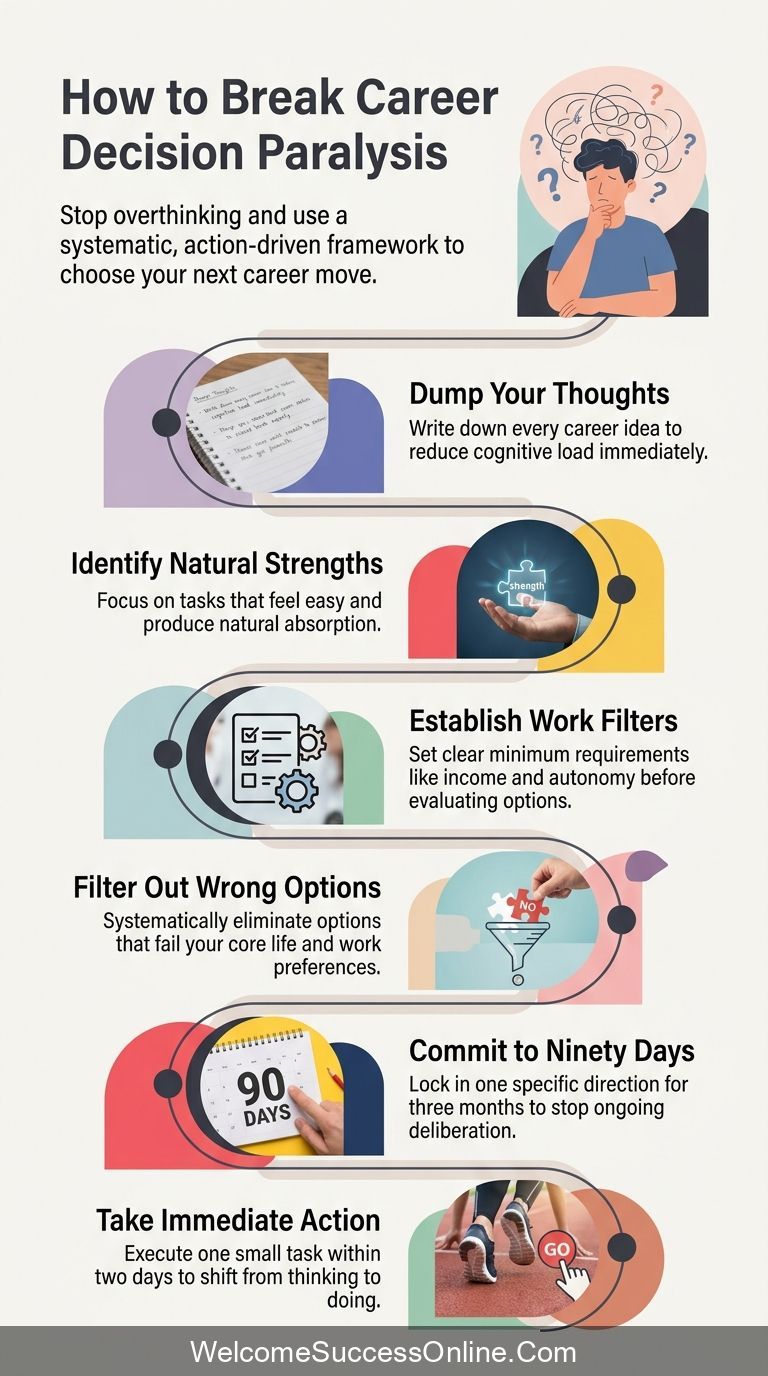
The process that consistently moves people out of long-term career indecision is not more reflection—it’s a structured sequence of small, specific actions that generate real information and produce a committed direction.
Here’s what that sequence looks like in practice.
Before you dive into the steps below, grab the free Starter Kit to start applying this as you go.
Step 1: Get Everything Out of Your Head
The first and most underrated step is a complete thought dump.
Write down every career idea you have ever seriously considered—including the ones you dismissed, the ones that seem unrealistic, and the ones you’ve never said out loud to anyone.
This isn’t a commitment list. It’s a clearing exercise.
When your options exist only inside your head, your brain has to hold them all simultaneously—which is part of what creates the overwhelm.
Getting them onto paper immediately reduces cognitive load and lets you actually work with the ideas rather than just carry them.
Research in cognitive psychology consistently shows that externalizing thoughts — writing them out — reduces mental load and improves the quality of decision-making. It’s one of the simplest interventions available and one of the most skipped.
Step 2: Build Your Strengths Picture — Honestly
Not the strengths you think you should have. Not the ones that sound impressive.
\The ones that show up naturally — that other people notice, that feel easier for you than they seem to for others, that produce a state of genuine absorption when you’re using them.
Three questions that surface real strengths consistently:
- What do people regularly come to you for help with, even outside of work?
- What tasks feel noticeably easier for you than they seem to for the people around you?
- Where have you improved unusually quickly—areas where the learning curve was shorter than expected?
Your answers to these questions reveal patterns in your natural abilities.
These are the foundations on which any sustainable career is built.
A career that runs counter to your natural strengths will always feel like effort. One built on them tends to feel like momentum.
Step 3: Define Your Non-Negotiables Before You Compare Options
Before evaluating any career option, establish your filters.
What conditions are genuinely required for your work satisfaction — not what would be nice, but what is structurally necessary?
Common non-negotiables include an income floor (the minimum you need to remove financial stress), work-location preferences, team size, degree of autonomy, and how much the work needs to feel meaningful versus being a means of funding other parts of your life.
Writing these down before evaluating options means you’re filtering based on values rather than mood.
It also means you can eliminate options quickly and objectively, rather than agonising over each one.
Step 4: Match, Then Eliminate — In That Order
Most people try to find the right answer.
A more effective approach is to systematically eliminate the wrong ones until only one or two remain.
First, generate a list of three to five career options that intersect your strengths, interests, and work-life preferences.
Don’t evaluate yet — just generate.
Then apply three elimination questions to each:
- Do I actually want to do the real daily work involved—not just the version I’ve imagined, but the actual tasks, the difficult moments, the ordinary Mondays?
- Does it genuinely fit my non-negotiables? Not mostly — genuinely.
- Am I willing to invest six to twelve months learning and building in this direction, even before I see significant results?
Any option that doesn’t pass all three gets cut.
What remains after that filter is usually one or two realistic directions, which is exactly the position you need to be in to make a decision.
Step 5: Make a Time-Bounded Commitment
This is the step most people resist most strongly and the one that matters most.
You don’t need to commit to this direction forever.
You need to commit to it for 90 days — genuinely, specifically, in writing.
Write this sentence and sign it: “For the next 90 days, I will focus on [specific direction].” — The physical act of writing and signing a commitment statement produces a measurably different psychological effect than keeping a decision in your head. It closes the loop. It stops the ongoing background deliberation. And it creates the starting point from which real clarity — the kind built through experience — can actually begin to develop.
Step 6: Act Within 48 Hours
The biggest risk after making a career decision is not acting on it immediately.
Within 48 hours, take one specific action—small enough to be achievable, concrete enough to be real.
It could be as simple as signing up for one course.
Sending one message to someone in the field you want to enter. You could spend two hours reading about the industry.
Write one paragraph about what your first month would look like.
The specific action matters less than the act of acting.
Movement changes your relationship with the decision.
It shifts you from “someone considering the issue” to “someone doing this”—and that shift has a greater impact on your clarity and confidence than any additional reflection.
Why This Works When Thinking Alone Doesn’t
The process above works for a specific reason: it generates real information rather than imagined information.
When you do the thought dump, you find out which options keep coming back, no matter how many times you’ve tried to set them aside.
When you do the strengths exercises, you find out what you actually do well, not what you think you should be good at.
When you apply the elimination filter, you find out which options survive contact with your real preferences rather than your theoretical ones.
And when you commit and act, you find out what the work actually feels like, which is the only information that ultimately resolves the question.
This is consistent with Stanford professor Bill Burnett’s research on designing careers: the people who find satisfying career directions are not the ones who thought the longest and hardest.
They are the ones who ran small, low-cost experiments — prototypes — that let them test directions in reality rather than in imagination.
You have been considering this long enough.
The information you need now is not available through more thinking. It’s available only through structured action.
–
–
An Honest Note on the Fear of Getting It Wrong
If you’ve been stuck for years, indecision almost certainly hides a fear underneath. It’s not just uncertainty; it’s actual fear.
Fear of choosing wrong, wasting more time, letting people down, or finding out that the thing you cared about most doesn’t work out.
That fear is worth naming directly rather than trying to think your way around it.
Here’s what I’ve found to be true, working through this issue with people at many different stages: the fear of choosing wrong is almost always more painful than actually choosing wrong.
A wrong choice, taken seriously and acted on fully, teaches you something real and specific that changes your next decision.
Prolonged indecision teaches you nothing — except that you’re the kind of person who stays stuck.
That’s not a judgment. It’s a description of what happens, and it’s entirely reversible.
But reversing it requires accepting that the next choice you make doesn’t have to be the right one forever — it just has to be better than the paralysis you’re currently in.
Almost every career direction has an entry point that doesn’t require burning everything down first. You can test directions, build skills, have conversations, and run small experiments — all without quitting your job, spending money you don’t have, or making dramatic announcements. The threshold for starting is almost always lower than it feels when you’re stuck in indecision.
Frequently Asked Questions
How do I know if I simply haven’t found the right career yet or if I’m afraid to commit to one?
A useful diagnostic: Have you eliminated options primarily because they didn’t interest you or primarily because they felt risky?
If most of your eliminations were fear-based—”What if I fail at it?” What if it doesn’t go well? “What if I’m not good enough?”—that’s avoidance rather than genuine filtering.
If you’ve eliminated options because they genuinely didn’t fit your strengths, values, or lifestyle requirements, that’s legitimate narrowing.
Most people in long-term indecision are doing a mix of both, and separating the two is a key first step.
Is it possible that I genuinely don’t know what I want?
It’s possible, but rarer than people think. More often, people have preferences they haven’t permitted themselves to act on—because they seem impractical, because they conflict with what others expect, or because committing to them feels vulnerable.
The thought dump exercise described above often brings these to the surface.
When people write down every idea without filtering, the options they keep coming back to tend to reveal preferences they already had but hadn’t fully acknowledged.
What if I’ve already tried structured approaches and they didn’t work?
The most common reason structured approaches don’t produce results is that people complete the reflection steps but skip the action steps.
Reading through a framework, filling in worksheets, and then returning to deliberation produces a more organized version of the same confusion.
The breakthrough almost always comes at the point of commitment and action — not at the point of completing an assessment.
If a previous approach didn’t work, the question worth asking is, “Did I actually commit to a direction and act on it, or did I go through the process and then continue weighing options?”
How long does it actually take to find career clarity?
For most people who engage seriously with a structured process, meaningful clarity develops within four to eight weeks of starting.
Full clarity — the kind that comes from real experience in a direction — usually takes three to six months. Research on career development consistently shows that the single strongest predictor of clarity is action taken, not time spent thinking.
People who act on an imperfect direction within weeks typically report more clarity at the three-month mark than people who spend those same three months continuing to deliberate.
What if I choose a direction and it turns out to be wrong?
You adjust. That’s genuinely the full answer.
A committed 90-day experiment in a specific direction provides you with information you cannot get any other way.
If that direction turns out to be wrong for reasons you couldn’t have known in advance, you now know something real and specific that changes your next decision.
That’s not failure — it’s progress.
The people who find genuinely satisfying career directions rarely get there in a straight line.
They iterated, adjusted, and built clarity through experience.
–
For a deeper dive, check out my guide on [I Don’t Know What Career to Choose: 7 Step Guide to Find Your Direction]
Stop Thinking. Start Deciding.
Career Clarity—Find Your Path in 7 Days is the structured workbook built for exactly this situation: years of thinking and no clear answer. It takes you through a day-by-day process that moves you from the confusion you’re in now to a specific, committed direction by Day 7. Every exercise. Every framework. No fluff.