

Feeling lost in your career isn’t a personal failure.
It’s one of the most common experiences working adults go through—and one of the least talked about, honestly.
You’re not lazy. You’re not ungrateful.
And you’re almost certainly not the only person in your office who goes home wondering whether this is really it.
What you’re experiencing has a pattern, and that pattern has a solution. This is not a quick fix; it is a real one.
This article breaks down why career confusion happens, how to recognize the specific form it’s taking for you, and what concrete steps actually move people through it.
I’ve worked with people across a wide range of industries and life stages—people who felt stuck at 24 and at 52.
The causes aren’t always the same, but the way out usually follows a similar path.
Why Feeling Lost in Your Career Is More Common Than You Think
A study of over 350,000 career changers found that 37% didn’t know what they wanted to do next professionally.
That’s not a minority — it’s more than one in three people who are actively trying to change direction and still can’t identify where they want to go.
The reasons vary. But they tend to cluster around a few recurring patterns.
You Chose a Path Based on Who You Were Then
Most career decisions get made under conditions that no longer apply. You chose your degree based on what you were interested in at 17.
You took your first job based on what was available.
You stayed because the salary improved, the alternative felt too risky, or you just didn’t have a clear enough reason to leave.
None of those are bad decisions in context. But they compound.
Five or ten years in, you can find yourself well into a career that was never really designed around who you actually are or what you actually want.
This isn’t a character flaw.
It’s just how careers often develop in the absence of deliberate planning.
The Work Has Changed (Or You Have)
Some people feel lost not because they chose wrong from the start, but because something shifted.
The job they used to find genuinely engaging became uninteresting.
The industry changed.
A new manager changed the culture. A major life event—a health scare, a loss, a move—reshuffled their priorities.
Feeling lost after a change like this isn’t a weakness.
It’s your sense of what matters that becomes clearer, which often makes the gap between your current situation and the one you actually want more visible.
The Passion Advice Made Things Worse
“Follow your passion” is probably the most repeated and least useful career advice in circulation.
It assumes everyone has a singular, clear passion; that this passion translates neatly into a viable career; and that, once found, it sustains indefinitely.
None of those things is reliably true.
Research by organizational psychologist Amy Wrzesniewski and others suggests that passion for work more often grows from competence and meaning than precedes them.
You get good at something, you start to matter to others through it, and the engagement follows—not the other way around.
If you’ve been waiting to feel passion before committing to a direction, that’s likely part of why you’re still stuck. The feeling usually comes after the commitment, not before it.
Fear Is Disguised as Uncertainty
A lot of career confusion is actually career anxiety.
The uncertainty feels like “I don’t know what I want,” but often means “I’m afraid of what happens if I choose and it doesn’t work out.”
Choosing means risking being wrong.
Starting over means accepting a temporary demotion in status or income.
Telling people you’re changing direction means dealing with their reactions.
These fears are real and worth acknowledging directly, because as long as they’re framed as uncertainty, they can’t be addressed.
Once they’re named as fears, they become manageable.
Recognizing the Specific Signs in Your Own Situation
Career loss doesn’t always look dramatic.
You might be performing well at work while feeling hollow about it.
You might not be able to articulate what’s wrong—just that something is. Here are some of the clearest indicators:
The Sunday Evening Test
How do you feel on Sunday evenings, thinking about the week ahead?
Mild reluctance is normal.
Dread, anxiety, or a persistent low mood that lifts only when you stop thinking about work — that’s a signal worth paying attention to.
This isn’t about loving every single aspect of your job.
No one does.
It’s about whether the overall sense of your work life is one of meaning and forward movement or one of treading water.
You’re Competent But Not Engaged
One of the harder forms of career confusion to identify is when you’re good at what you do but don’t actually care about doing it.
You perform well enough to stay, receive reasonable feedback, and have no concrete reason to leave—but you’re not engaged.
This pattern is common among people who are technically skilled and have been rewarded for those skills but whose jobs were built around capability rather than fit.
The work doesn’t activate anything meaningful for them.
You’ve Stopped Growing (Or Stopped Caring About Growing)
When people are genuinely engaged in their work, they tend to want to get better at it.
They find aspects of their field interesting beyond what their job requires.
They think about it outside of work hours.
When that stops — when professional development feels like a box-ticking exercise and the idea of being good at this particular job indefinitely produces no positive feeling — that’s often a sign of misalignment rather than laziness.
You’re Comparing Yourself to Others More Than Usual
A sharp increase in career envy—noticing other people’s jobs, LinkedIn posts, and career paths—often signals dissatisfaction with your own direction.
Not because comparison is inherently problematic, but because it tends to spike when the gap between where you are and where you want to be feels most acute.
Why the Usual Advice Doesn’t Move You Forward
Most people who feel stuck have already tried some version of the following: taking a personality test, thinking harder about what they want, reading career books, or waiting for inspiration.
None of it produced a lasting breakthrough.
Here’s why.
| Common Approach | Why It Feels Like Progress | Why It Often Doesn’t Work |
| Taking personality tests | Produces self-awareness | Self-awareness without action doesn’t change anything |
| Thinking more about it | Feels responsible and thorough | More thinking without new input creates more of the same conclusions |
| Waiting for clarity before acting | Feels safe and sensible | Clarity usually comes after action, not before it |
| Reading books about purpose | Inspiring and validating | Inspiration without a system doesn’t translate to decisions |
| Asking people what you should do | Helpful for input | Others can’t see your internal priorities clearly enough to answer well |
The problem with most of these approaches is that they’re inputs without outcomes.
They generate more information or more feelings without producing a decision or an action.
What actually moves people forward is a structured process that forces specific outputs at each stage.
Before you dive into the steps below — grab the free Starter Kit to start applying this as you go.
–
–
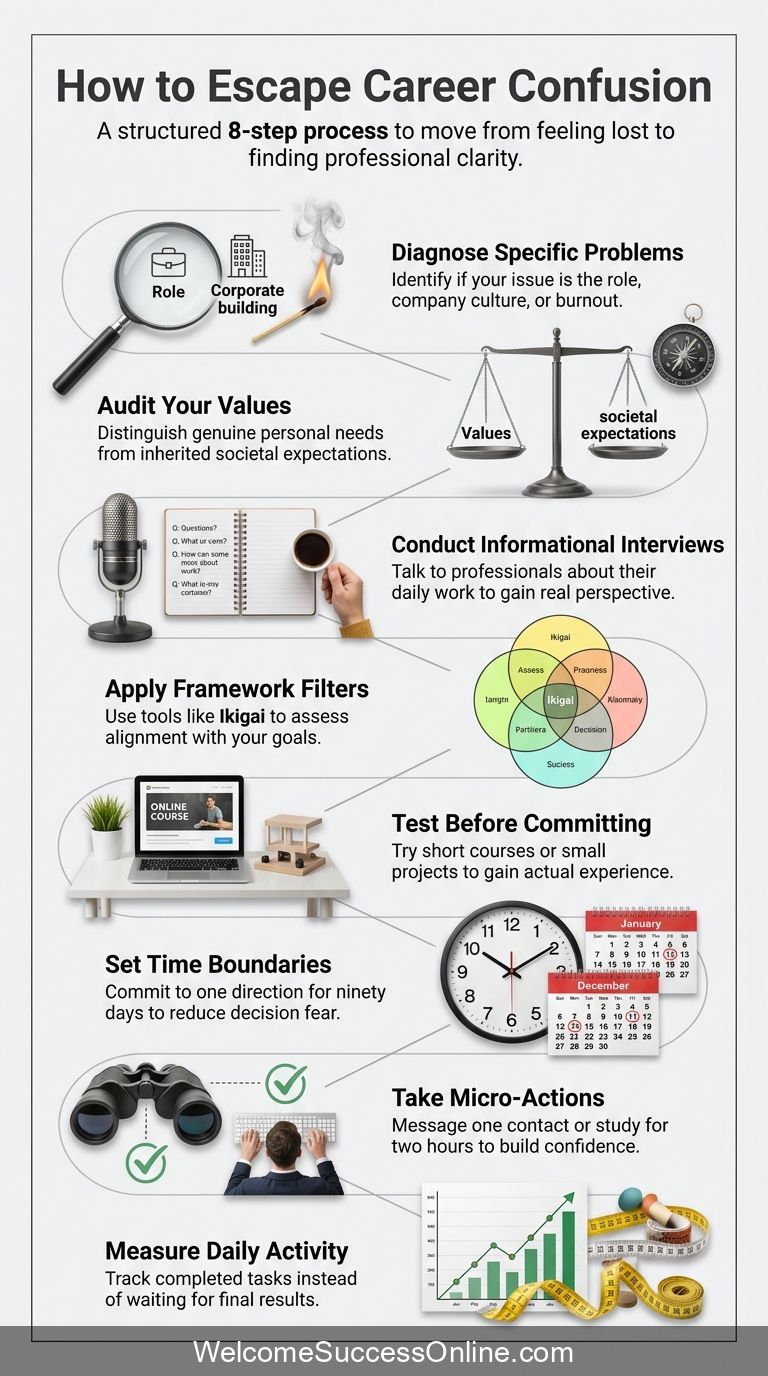
What Actually Helps: A Practical Process for Getting Unstuck
The following steps are drawn from what consistently works when people genuinely move through career confusion — not just manage it.
1. Name What’s Wrong With Specificity
“I’m unhappy at work” is a starting point, not a diagnosis.
Before you can fix the right problem, you need to identify which problem you’re actually dealing with.
There’s a significant difference between the following:
- Wrong role: the type of work itself doesn’t suit you
- Wrong organization: the work could be fine, but the company, culture, or management makes it untenable
- Wrong stage: you’ve outgrown what you’re doing and need more challenge, responsibility, or scope
- Wrong field: the industry itself no longer aligns with your values or priorities
- Burnout: you’re exhausted and depleted in a way that’s affecting your ability to assess anything clearly
These require different responses. Burnout calls for recovery before decision-making.
The wrong organization might mean a lateral move rather than a full career change.
“Wrong field” means something more significant.
Treating these as the same problem produces solutions that don’t fit.
2. Separate Values From Assumptions
One of the most useful exercises I put people through is asking them to write down what they want in their next career move.
Then, separate each item into two lists: genuine values (things that would actually matter to them in day-to-day life) and assumptions (things they think they should want or have inherited from family or culture).
The list of assumptions is often longer than people expect.
“I need to be in a prestigious field” is often an assumption.
“I need to feel like my work matters” is usually a genuine value.
“I need to earn above a certain income” might be either, depending on whether it reflects a genuine lifestyle requirement or a status comparison.
Decisions built on genuine values tend to produce lasting satisfaction.
Decisions built on assumptions tend to produce the same dissatisfaction in a different context.
3. Get Out of Your Head and Into the World
The single most consistently effective action for people who feel stuck is to have conversations with those already doing work they find interesting.
Not job interviews — informational conversations.
Ask someone whose career you’re curious about whether they’d spend 20 minutes explaining what their work looks like day to day. Most people say yes.
Most people enjoy talking about their work with someone who’s genuinely curious.
These conversations do things that internal reflection can’t.
They give you real-world texture — the parts of a job that never appear in a job posting.
They often introduce you to adjacent paths you hadn’t considered.
And they break the isolation that tends to make career confusion feel bigger than it is.
LinkedIn is a practical tool for identifying people whose career trajectory interests you. A short, specific, genuine message—explaining that you’re considering a career transition and would value 20 minutes of their time and perspective—has a surprisingly high response rate when delivered respectfully.
4. Run a Values-Fit Audit on Your Shortlist
Once you have a small number of directions worth considering, assess each one against your genuine values—not what sounds good, but what would actually matter in practice.
The O*NET Interest Profiler (free, from the US Department of Labor) can help surface career categories aligned with your interest patterns if you’re genuinely uncertain about direction.
The Ikigai framework — mapping what you’re good at, what you enjoy, what you can be paid for, and what the world needs — is a useful filter for assessing whether a direction is likely to be genuinely satisfying or just appealing in theory.
5. Test Before You Commit
Career decisions don’t have to be binary—all in or stay put. Most directions can be tested in some form before a major commitment is required.
- Have three or four informational conversations with people in the field
- Take a short course to see if the subject matter genuinely engages you (Coursera and LinkedIn Learning both offer low-cost options)
- Take on a small project or volunteer role that touches the work you’re considering
- Attend one industry event or join one professional community in the field
Each of these generates real information — not research about a career, but actual experience of some version of it.
That information is worth more than months of internal deliberation.
6. Make a Time-Bounded Decision
At some point, the goal shifts from gathering information to making a decision.
The way to make that feel less final than it is: give it a time boundary.
“For the next 90 days, I am going to pursue this direction seriously” is a different kind of commitment than “this is my career forever.”
The first is testable, adjustable, and specific enough to act on.
The second is the kind of permanent-feeling choice that keeps people in deliberation for years.
Write it down: “For the next 90 days, I will focus on [specific direction].” Keep it somewhere visible. This kind of explicit commitment produces different behavior than keeping the decision vague and in your head.
–

–
Building the Confidence to Actually Move
Most people who feel stuck don’t lack information.
They lack confidence that acting on the information will go well. Here’s what helps.
Reframe Past Setbacks as Career Data
A job that didn’t work out isn’t a failure — it’s evidence about what doesn’t suit you, which is genuinely valuable information.
A degree you’re not using isn’t wasted—it builds reasoning skills, discipline, and knowledge that transfer in ways you may not be fully accounting for.
Every professional experience contains transferable value.
The work is identifying what that value actually is, not treating the experience as either a triumph or a write-off.
Adam Grant’s research on resilience, documented in Think Again, shows that people who treat their career decisions as experiments rather than identity commitments tend to adapt more successfully when things don’t go as planned.
The shift in framing matters more than people expect.
Start With the Smallest Possible Action
Confidence in career decisions doesn’t come from certainty—it comes from evidence that you can act.
The best way to build that evidence is to start with actions small enough that they’re genuinely doable this week.
- Message one person on LinkedIn whose career interests you
- Spend two hours on one module of a course in a field you’re curious about
- Write one paragraph describing what your ideal working day would look like
- Read one industry report or publication in a field you’re considering
None of these requires leaving your job, committing to anything, or having certainty about where you’re going.
They require only that you act on your curiosity in a small, specific way.
That’s how confidence builds — through evidence of action, not through reassurance.
Talk to People Who Have Made Transitions
One of the most effective confidence builders is hearing from people who were where you are and moved through it.
Not inspirational stories of overnight transformation—real accounts of how someone gradually figured out a new direction, what the messy middle looked like, and what they’d tell themselves if they could go back.
These conversations normalize the uncertainty and provide practical models.
They show that the path forward doesn’t require perfect clarity upfront — it requires enough direction to take the next step.
How to Stay Motivated When Progress Feels Slow
Career transitions take longer than people expect, and they’re rarely linear.
There will be periods where nothing seems to be moving.
Here’s how to manage those stretches.
Measure Activity, Not Just Outcomes
In the early stages of a career transition, you have control over your activity but limited control over outcomes.
You can control how many informational conversations you have this month.
You can’t control whether any of them leads directly to an opportunity.
Measuring and celebrating the activities—the conversations held, the courses started, the applications sent, and the new connections made—keeps momentum alive during the stretches where outcomes haven’t materialized yet.
Protect Your Energy
Career transitions are cognitively and emotionally demanding on top of whatever else you’re managing in your life.
The American Psychological Association’s research on decision fatigue consistently shows that cognitive load reduces decision quality.
If you’re running on poor sleep, no exercise, and constant stress, your ability to think clearly about a significant life decision is compromised.
This isn’t soft advice. It’s practical.
Protecting your physical and mental health during a career transition isn’t a luxury — it’s a condition for making good decisions.
Set a Review Date, Not Just Goals
Rather than setting goals without a check-in structure, commit to a specific review date—six or eight weeks from now—when you sit down and honestly assess: What have I learned, what have I acted on? And does my current direction still feel right?
This builds in the kind of regular course-correction that keeps transitions on track without requiring you to have everything figured out at the start.
Frequently Asked Questions
Is it normal to feel lost in your career even when things look fine from the outside?
Yes, and it’s more common than most people admit.
You can be performing well, earning a reasonable income, and appearing successful while feeling genuinely disconnected from your work.
External markers of career success don’t determine internal satisfaction—alignment between your values, strengths, and daily work does.
How long does it typically take to find a new career direction?
There’s no fixed timeline, and anyone who gives you one is oversimplifying.
What research consistently shows is that people who take structured, active steps — informational interviews, testing, small commitments — move through confusion faster than those who wait for clarity to arrive on its own.
Six to twelve months of consistent, active work on the question is a reasonable expectation for most people. Some move faster; some take longer.
Should I change careers or just change jobs?
Start by diagnosing the source of your dissatisfaction. If the problem is primarily your manager, your company’s culture, or your specific role, a job change within your field may be sufficient.
If the problem is the nature of the work itself or a fundamental conflict between the field’s demands and your values, that usually points toward something more significant.
The distinction matters because a career change requires a different kind of preparation and a longer runway than a job change.
What if I’ve tried many things and still feel lost?
If you’ve done genuine work on the question over a sustained period and still feel stuck, it may be worth working with a career coach who can provide structured guidance and an outside perspective on patterns you can’t see clearly from inside.
Not all coaches are equally useful — look for someone whose approach is practical and evidence-based rather than purely inspirational.
Some employers and employee assistance programs also offer access to career counseling as part of their benefits.
Can I feel lost in my career even if I’ve always been successful?
This is one of the most common situations.
High achievers often build successful careers on capability—doing things they’re good at, being rewarded for performance—without ever checking whether the work is genuinely aligned with what they want.
Success in a field you’re not suited to can feel just as hollow as failure in one you care about.
The solution is the same: honest assessment of values, strengths, and what a genuinely satisfying working life would look like for you specifically.
For a deeper dive, check out my guide on [I Don’t Know What Career to Choose: 7 Step Guide to Find Your Direction]
A Structured Way to Find Your Next Direction
If this article resonated, the next step is to work through a structured process — not just read about it.
The Career Clarity — Find Your Path in 7 Days guide provides a day-by-day framework and exercises that guide you from confusion to a clear, committed direction. No fluff, no generic advice — just a practical system that works.
3 thoughts on “Why You Feel Lost in Your Career — And How to Find Your Way Out”
Comments are closed.