

Reading about a career and spending a day in one are two completely different experiences. Job shadowing closes that gap—it’s one of the few ways to get real exposure to a role before making any actual commitment to it.
It’s also one of the most underused tools in career exploration, mainly because people think it’s harder to arrange than it is or that it exists only for students.
Neither is true.
Here’s what job shadowing actually involves, how to set one up as a working adult, and what to pay attention to once you’re there.
What Job Shadowing Actually Is (And Isn’t)
Shadowing means spending time—typically a few hours to a full day—observing someone doing their actual job. You’re not there to work, contribute, or be evaluated.
You’re there to watch, ask questions during natural pauses, and get a direct sense of the role’s real rhythm.
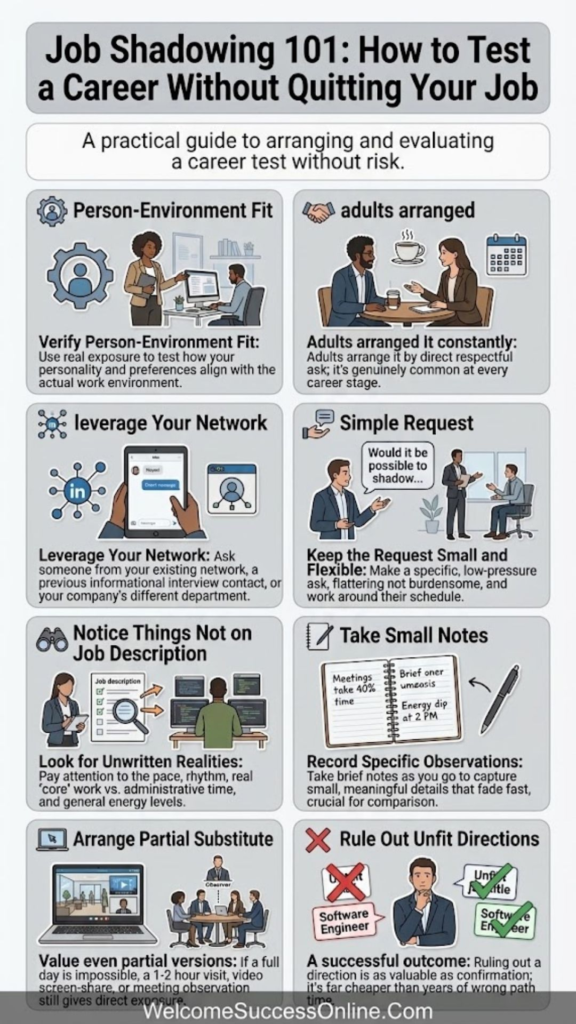
This matters because of a well-established idea in career research: person-environment fit theory holds that satisfaction and success depend heavily on how well someone’s personality and preferences match their actual work environment—and that fit is very difficult to judge accurately from the outside.
–
How to Actually Arrange One as a Working Adult
Shadowing isn’t just for students on career days.
Adults arrange it constantly—it just requires asking directly, as an informational interview does.
Who to ask
- Someone from your existing network already in the role or industry
- A contact from a prior informational interview—a natural next step once trust is established
- Your own company, if the role exists in a different department—often the easiest version to arrange, since you’re already inside the organization
How to ask
“I’ve really enjoyed learning more about what you do, and I’m seriously considering this direction. Would it be possible to shadow you for a few hours sometime, just to see what a typical day actually looks like? I’d work around whatever’s easiest for you.”
Most people are more open to this than expected—being asked to let someone observe their work is often flattering rather than burdensome, especially when you keep the request small and flexible.
Try This Now Think of one person in your network—or one department in your own company—where a half-day shadow visit would be realistic to ask for. Write down what you’d say if you reached out today. |
–

–
What to Actually Pay Attention To
The value of shadowing isn’t in watching tasks get completed—it’s in noticing things that never show up in a job description.
- The pace and rhythm of the day—is it steady, bursty, or unpredictable?
- How much of the day is the “core” work you imagined, versus meetings, admin, or unrelated tasks?
- The person’s energy at different points—do they seem drained by certain tasks, energized by others?
- How people around them talk about the role, not just the person you’re shadowing
Take notes as you go, even brief ones.
Details fade fast, and the small, specific observations — not the general impression — are usually what matters most when you’re comparing this option to others.
What If You Can’t Arrange a Full Shadow Day?
A full day is ideal but not required to get real value.
A partial substitute still beats research alone:
- A 1–2 hour visit during a specific part of the day (e.g., a team’s morning stand-up plus a working session)
- A video call where the person walks you through their actual workspace or a recent project, screen-share style
- Attending one relevant meeting as an observer, if the person is comfortable with it
Any of these narrows the gap between imagination and reality—the goal is direct exposure, not a perfect replica of a full working day.
Not Sure Which Role Is Worth Shadowing? If you haven’t narrowed down a direction yet, the free Career Clarity Starter Kit is a fast way to surface a real starting point—five questions that point you toward something worth testing directly. |
Conclusion
Job shadowing is one of the most direct, low-risk ways to test whether a career actually fits—not the idea of it, but the real daily rhythm, energy, and texture of the work.
It requires nothing more than a specific, low-pressure ask, and most people are more willing to say yes than the anticipation suggests.
Even a partial version—a few hours, a screen-share walkthrough, one observed meeting—gives you real information no amount of independent research can replace.
It’s a small ask that consistently produces an outsized return in clarity.
Frequently Asked Questions
1. Is job shadowing appropriate for adults changing careers or just students?
It’s genuinely common at every career stage.
Adults exploring a career change arrange shadow visits regularly—the request itself doesn’t require any student status or formal program, just a direct, respectful ask.
2. What if my current employer finds out I’m shadowing someone in another field?
If you’re shadowing outside your current company, this generally isn’t a concern.
If it’s within your own company (a different department), most employers view internal exploration positively—it signals engagement and can be framed as broadening your understanding of the business.
3. How do I know what to ask during natural pauses without being intrusive?
Save more involved questions for a lull rather than interrupting active work, and take cues from the person’s pace—quick clarifying questions in the moment are usually welcome, while deeper discussion questions are better saved for a short debrief at the end of the visit.
4. What if the shadow experience makes me realize I don’t want this career after all?
That’s a genuinely successful outcome, not a wasted one.
Ruling out a direction with real information is exactly what shadowing is for—it’s far cheaper to learn the truth in a single afternoon than to learn it after committing months or years to the wrong path.
Ready to Turn What You’ve Seen Into a Real Decision?
The Career Clarity Bundle: Find Your Path in 7 Days gives you a structured way to weigh what you’ve learned from shadowing and conversations against your strengths and lifestyle needs—so the experience actually leads somewhere.

Download it here → Career Clarity—Find Your Path in 7 Days
If you’re not there yet, start with the free Career Clarity Starter Kit—five questions that give you a real first read on your direction.

Get the Starter Kit → welcomesuccessonline.com/starter-kit/