
Most career research answers questions like “what does this job pay?” and “what’s the growth outlook?”
Almost none of it answers the question that actually matters most: what does it feel like to do this work, on an ordinary Tuesday, six months in?
There’s only one reliable way to get that answer—ask someone who already knows about their salary.
An informational interview is a short, low-pressure conversation with someone doing the work you’re considering, and it consistently produces more useful information than hours of independent research.
Most people avoid them because asking for an informational interview feels awkward. Here’s how to make the ask easy and what to actually discuss once someone says yes.
–
–
Why This Works Better Than Almost Anything Else
A job posting tells you what an employer wants to advertise.
A “day in the life” article tells you what a writer thought would get clicks.
A person actually doing the job, asked directly and given permission to be honest, tells you something closer to the truth.
Career development research consistently identifies direct information gathering from people in a field as one of the strongest predictors of a satisfying career transition — more so than personality assessments or independent research alone.
The reason is simple: you’re replacing assumptions with evidence gathered from questions to ask during your job search.
Even a single 20-minute conversation can confirm or completely overturn what you thought a role involved.
How to Actually Ask (Without It Being Weird)
The awkwardness people anticipate almost never matches the reality.
Most professionals enjoy talking about their work, especially when the request is specific, respectful of their time, and clearly not a disguised job application.
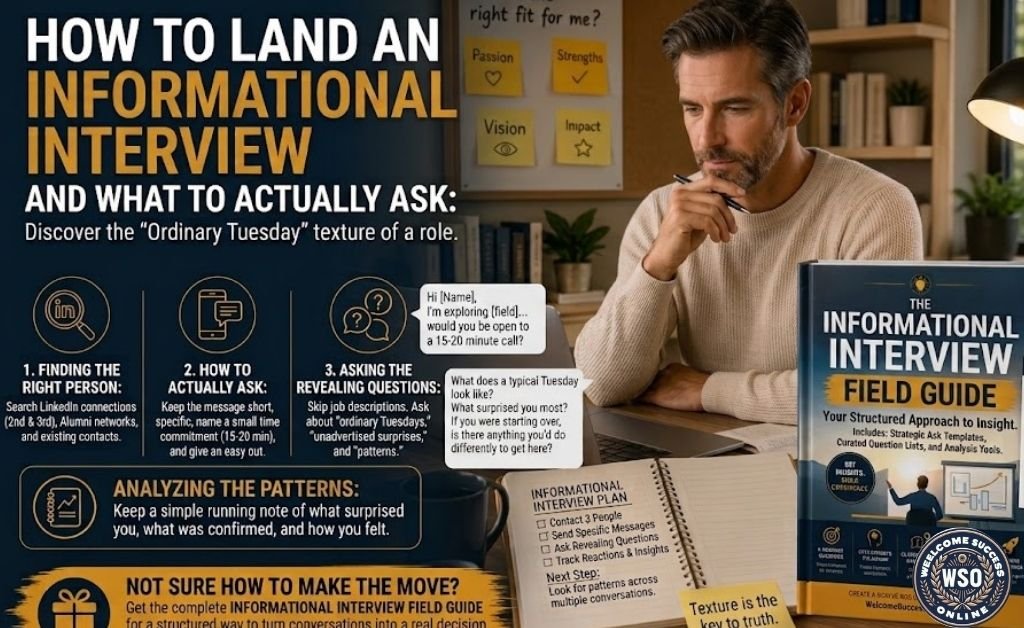
Finding the right person
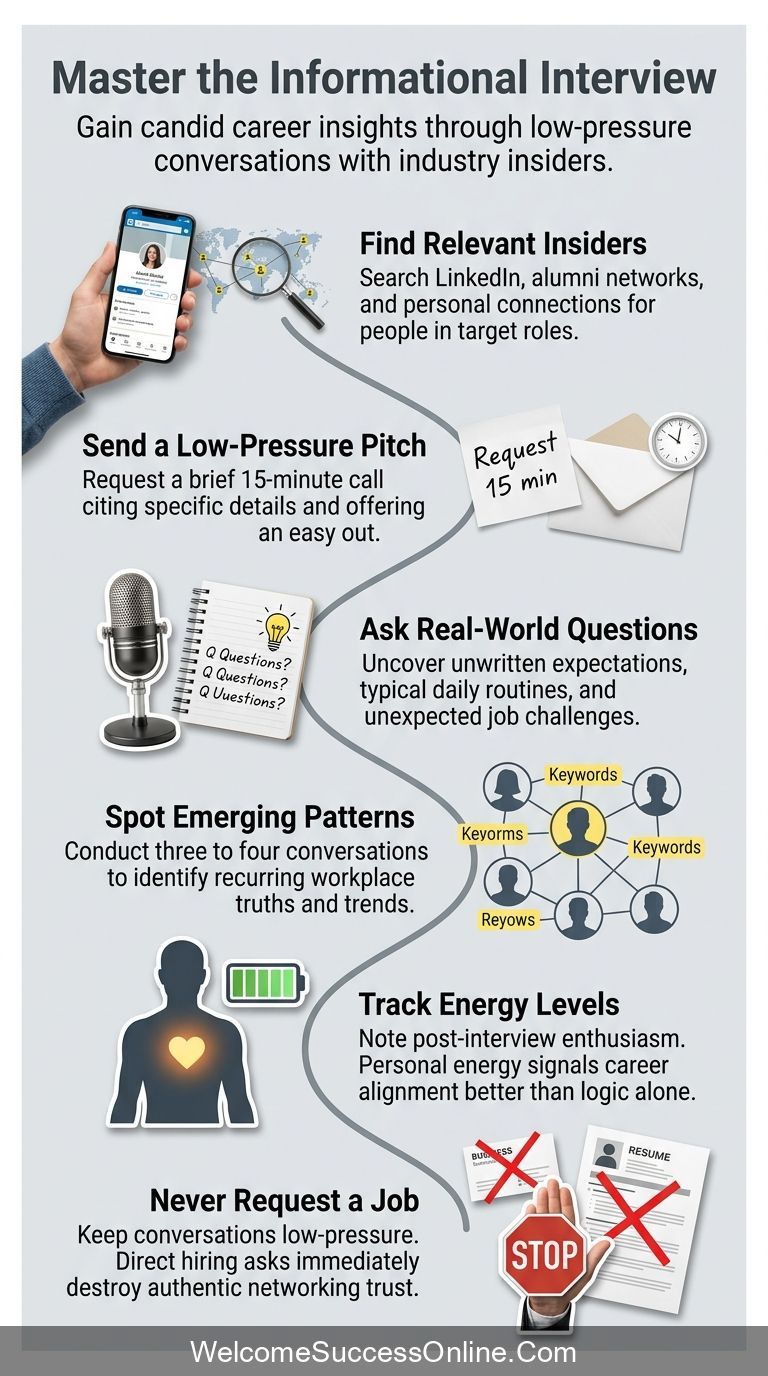
- LinkedIn — search by job title and industry, filter by second or third connections if possible
- Alumni networks — many universities have searchable databases specifically built for this
- Existing connections—ask people you already know if they know anyone in the field; this often gets a faster, warmer response than a cold message
What to actually say
Keep the message short, specific, and easy to say yes to.
A message that’s too long or too vague is easy to ignore.
“Hi [Name], I’m exploring a move into [field] and came across your background in [specific detail from their profile]. Would you be open to a 15–20 minute call sometime in the next few weeks to discuss your resume? I’d love to hear what the day-to-day actually looks like in your career path. Completely understand if timing doesn’t work.”
Notice what this does: it’s short, it references something specific about them (not a mass copy-paste), it names a small time commitment, and it gives them an easy out.
That combination consistently produces a higher response rate than longer, more formal requests.
Try This Now Identify three people whose current role touches on something you’re considering. Don’t message them yet — just find them and note one specific, genuine detail about each that you could reference in an opening line. . |
–
–
The Questions That Actually Reveal Something
Most people waste an informational interview asking questions the internet could already answer—”What does a [job title] do?”
The better questions get at texture, not just job descriptions.
- What does a typical Tuesday actually look like for you?
- What’s the part of this job that never shows up in the job description?
- What surprised you most once you were actually in the role?
- What kind of person tends to struggle here, and what kind tends to thrive?
- If you were starting over, is there anything you’d do differently to get here?
Notice these all invite a real, specific answer rather than a generic one.
“What do you do?” gets you a job description. “What surprised you?” gets you the truth.
–
–
What to Do With What You Learn
One conversation is a data point, not a verdict.
The real value shows up after three or four conversations, when patterns start to appear—the same frustration mentioned twice, the same unexpected upside brought up independently by two different people.
Keep a simple running note after each conversation: what surprised you, what confirmed what you expected, and how you felt afterward.
That last one matters more than people think — energy and enthusiasm after a conversation is often a more honest signal than how interesting the conversation felt in the moment, especially regarding the interviewee’s career path.
Still Narrowing Down Who to Ask in an Informational Interview? If you’re not sure which direction is even worth an informational interview yet, the free Career Clarity Starter Kit gives you a fast first read—five questions that point you toward a direction worth investigating. . |
Conclusion
Informational interviews are one of the highest-leverage, lowest-cost ways to test a career direction—more revealing than another article and far less risky than committing to a path you haven’t actually investigated.
The hesitation to ask is almost always greater than the actual difficulty of doing so.
Start small: three people, one short, specific message each, and a list of questions designed to surface texture rather than job-description facts.
A pattern across three or four conversations will tell you more than weeks of research ever could.
Frequently Asked Questions
1. What if the person says no or doesn’t respond?
Completely normal and rarely personal—people are busy, and messages are often missed.
Reach out to several people rather than pinning hopes on one, and follow up once, politely, after a week or two if you haven’t heard back.
2. Should I ask for a job at the end of the conversation?
No — that’s the fastest way to make future requests feel transactional and reduce response rates for you and others.
If the person offers to help further, that’s a natural next step; asking directly turns a low-pressure conversation into something it wasn’t advertised to be.
3. How many informational interviews should I aim for before deciding?
Three to four per option is usually enough to spot real patterns rather than one person’s individual experience.
Fewer than that risks generalizing from a potentially unrepresentative single perspective.
4. Is it different if I’m trying to change industries entirely versus just changing roles?
The approach is the same, but expect to lean more heavily on cold outreach (LinkedIn, alumni networks) since you’ll likely have fewer existing connections in a brand-new industry.
Being upfront that you’re exploring a transition, rather than implying existing experience, tends to build more trust.
Ready to Turn Conversations Into a Real Decision?
The Career Clarity Bundle: Find Your Path in 7 Days gives you a structured way to combine what you learn from real conversations with a clear framework for deciding—so insight doesn’t just sit as notes you never act on.
Download it here → Career Clarity — Find Your Path in 7 Days
If you’re not there yet, start with the free Career Clarity Starter Kit—five questions that give you a real first read on your direction.