

You’ve already done the most difficult part. You’ve researched, talked to a few people, maybe even tested something small.
Now you have two or three real options, but you still can’t choose one.
That is a different problem from the one most career advice solves.
Plenty of articles help you find options. Very few show you how to choose between them.
This post gives you a simple, repeatable framework for career decision making: five steps you can work through in about a week, using what you already know plus a little new evidence.
It works whether you’re choosing between two career paths, two specific roles, or a new direction and staying where you are.
–
–
Why Good Decisions Feel So Hard, Even After Research
Most people assume that enough information will make the answer obvious.
It usually doesn’t. Past a certain point, more research adds more data without adding clarity.
We cover that point in our guide to how long career exploration should take, and the short version is that exploration needs an endpoint, or it quietly becomes a way of avoiding the decision.
There’s also a well-documented reason that comparing options is mentally costly. In a widely cited study, researchers
Sheena Iyengar and Mark Lepper set up tasting tables with either 6 jams or 24. Of the shoppers who stopped at each table, roughly 30% bought from the small display, against about 3% at the large one.
The larger display drew more attention and produced fewer decisions.
Later research shows the effect isn’t universal, but it is most likely to occur when there are many options that are hard to compare and when you aren’t sure what you want, which describes most career decisions.
You can read the original findings in Iyengar and Lepper’s study on choice overload.
How you approach the choice matters too.
Psychologist Barry Schwartz and colleagues found that “maximizers,” people who try to find the single best option, tended to report lower happiness and life satisfaction and more regret than “satisficers,” who seek an option that meets their needs and stop there.
The details are in their study of maximizing versus satisficing.
The practical takeaway for a career decision: aim for a strong fit that meets your requirements, not a perfect one that doesn’t exist.
–

–
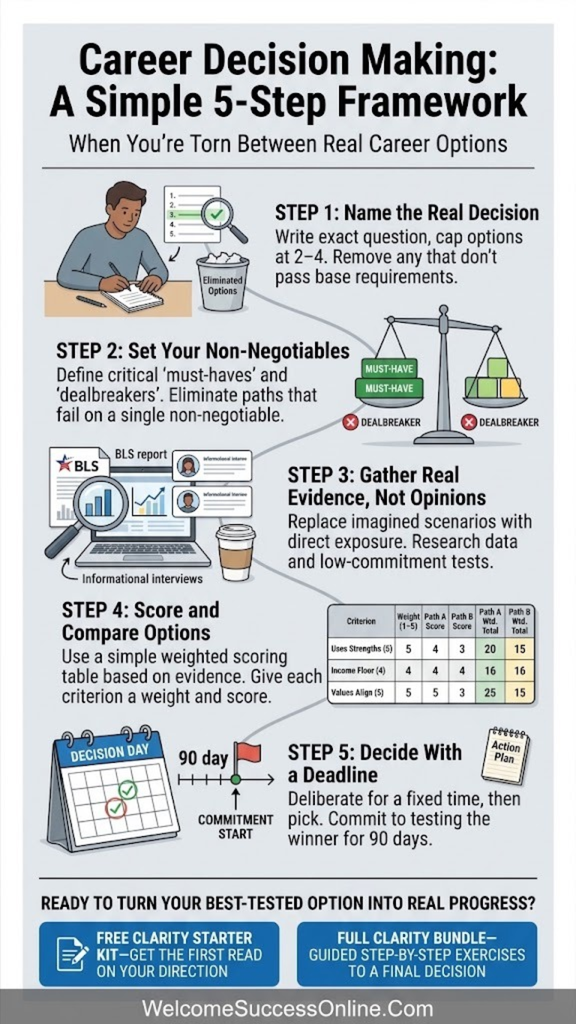
The 5-Step Career Decision Making Framework
Work through these in order.
The most common mistake is jumping straight to the comparison in Step 4, before the earlier steps have narrowed and sharpened what you’re comparing.
Step 1: Name the Real Decision
Write down the exact question you’re answering. “What should I do with my life?” can’t be answered.
“Which of these two paths will I commit to for the next 90 days?”
Then cap the list.
Two to four options are workable.
Ten is not. If you have more, narrow them with three quick questions:
- Do I want the real daily work, or just the idea of it?
- Am I willing to spend six months or more learning it?
- Does it clear my basic life requirements, such as income and working setup?
Anything that doesn’t meet one of these criteria is removed from consideration.
You aren’t choosing yet.
You’re deciding what deserves a real comparison.
Step 2: Set Your Non-Negotiables
Your strengths tell you what you’re capable of.
Your non-negotiables tell you the conditions you need to sustain it.
Be specific about:
- Your income floor, meaning the amount that removes financial stress, not your ceiling
- Your working setup: remote, office, or flexible
- Pace and structure: predictable routines or open-ended problems
- People: team-based work or mostly solo
- Values: what the work contributes to, and what you won’t compromise on
Any option that fails to meet a non-negotiable is eliminated.
This is elimination, not scoring. A dealbreaker shouldn’t be averaged away by a list of nice extras.
| – Try This Now Write down three things a career must have for you to say yes, and two things that would make you say no no matter how good the rest looks. – |
| – Not Sure What Your Non-Negotiables Are? The free Career Clarity Starter Kit is a fast way to surface your strengths and lifestyle preferences. Five questions that give you a clear first read on what you need before you compare anything. – |
Step 3: Gather Evidence, Not Opinions
Right now, most of what you know about each option is imagined: how it sounds and how you picture the days.
Replace imagination with real exposure.
Start with the basics in the Bureau of Labor Statistics Occupational Outlook Handbook, which covers what workers do, typical pay, education requirements, and job outlook for more than 300 occupations.
Then go one level deeper, using our guide to how to research a career before you commit to it.
Then test each surviving option in a small, low-commitment way:
- Talk to someone who does the job. Here’s how to get an informational interview and what to ask.
- Spend a day alongside them. Job shadowing lets you test a career without quitting your job.
- Try a small piece of the real work. This comparison of side projects, courses, and volunteering helps you pick the right test.
Afterward, pay attention to how you feel in the hours that follow.
Energy tells you more than excitement beforehand, and we explain how to track it in how to know if you’ll enjoy a job before you take it.
Write your reaction down while it’s fresh, because it becomes the evidence for Step 4.
–

–
Step 4: Score and Compare
Once each option has some real evidence behind it, put them side by side.
A simple weighted scoring table does this better than a plain pros and cons list.
In a pros and cons list, every item counts equally, so a long run of small perks can outweigh a single dealbreaker.
Weighting makes you identify what matters most.
Here is how it works:
- Pick five to seven criteria from the earlier steps, such as strengths use, lifestyle fit, values, income, growth, and energy after testing.
- Give each criterion a weight from 1 to 5 for how much it matters to you. Do this before you score anything, so you can’t tilt the result.
- Score each option from 1 to 5 on each criterion, using the evidence you gathered in Step 3.
- Multiply each score by its weight, then add up the totals.
A short example with two options:
–
| Criterion | Weight (1–5) | Option A | Option B |
| Uses my strengths daily | 5 | 4 | 3 |
| Fits my lifestyle requirements | 5 | 3 | 5 |
| Energy after testing | 4 | 3 | 4 |
| Meets my income floor | 4 | 4 | 3 |
| Room to grow | 3 | 5 | 3 |
| Weighted total (out of 105) | 78 | 77 |
–

–
The totals are almost identical, and that is useful information.
A near tie doesn’t mean the method failed.
It means both options are viable, so the tiebreaker isn’t more scoring. It’s Step 5.
Step 5: Decide With a Deadline, Then Commit for 90 Days
Pick a decision date, within a week or two, and decide on that day based on whatever the table says.
Open-ended deliberation is itself a decision to stay stuck.
Then frame the choice correctly.
You aren’t choosing a career forever. You’re choosing what to focus on for the next 90 days, based on the evidence you’ve gathered.
That is a testable, reversible commitment, not the irreversible one it can feel like.
Write it down:
“For the next 90 days, I will focus on ____. My first action in the next 48 hours is ____.”
Make the first action small enough to finish tonight: one message sent, one course module opened, one hour of reading.
The commitment ends the deliberation, and the experience that follows produces the kind of clarity no amount of comparing can give you.
When Your Gut and the Numbers Disagree
If the winning option makes your stomach drop, don’t ignore the feeling, and don’t obey it blindly either.
Ask what it’s about.
- If it’s specific (“I’d hate the commute,” “I don’t want that kind of manager”), you’ve found a missing criterion. Add it to the table and rescore.
- If it’s vague (“I’m just scared”), it’s most likely fear of the unfamiliar, which is normal with any big change. Run a small test of the winning option before overturning the result.
Either way, your reaction is data about the option or about the decision, and both are worth knowing before you commit.
Conclusion
Career decision making is hard because the problem changes after exploration.
You no longer need more options or more information.
You need a way to weigh what you have and a point at which you stop weighing.
Name the decision, set your non-negotiables, gather real evidence, score what matters most, then decide by a deadline and commit for 90 days.
A strong, well-tested choice you act on beats a perfect one you never make.
Frequently Asked Questions
1. How many career options should I compare at once?
Two to four. Fewer than two isn’t a comparison, and more than four makes the scoring so heavy that you stop trusting it. If you have more, use the three narrowing questions in Step 1 first.
2. What if two options score the same?
A near tie means both are viable, which is good news. Choose the one that costs less if you’re wrong or is easier to reverse, or run a two-week test of each and decide on your deadline.
Don’t keep rescoring while searching for a winner.
3. How long should a career decision take?
The framework fits into about a week of focused effort once you’ve done your research.
The full process from first exploration to decision typically takes 8 to 12 weeks, after which more exploration tends to add data without adding clarity.
4. Is it okay to decide with incomplete information?
Yes. You will never have complete information about a career you haven’t done yet.
Decide when you have enough evidence to compare your options fairly, then treat the choice as a 90-day experiment that will teach you the rest.
–
| – Ready to Turn This Framework Into a Decision? The Career Clarity Bundle: Find Your Path in 7 Days is the guided version of these steps. Days 4 to 7 take you through matching your strengths to options, eliminating the wrong paths, choosing one direction, and building a simple action plan, with a worksheet for each. – |
–

Download it here → Career Clarity—Find Your Path in 7 Days
If you’re not there yet, start with the free Career Clarity Starter Kit: five questions that give you a real first read on your direction.
–
Get the Starter Kit → welcomesuccessonline.com/starter-kit/
1 thought on “Career Decision Making: A Simple 5-Step Framework (When You’re Torn Between Options)”
Comments are closed.