

Most people research a career the same way they research a vacation destination: skim a few articles, look at some photos, check the average cost, and call it decided.
That works fine for a vacation.
It doesn’t work for a career, because the thing you’re actually trying to learn—what it feels like to do this work, day after day, for years—almost never shows up in the surface-level research most people stop at.
This isn’t about researching more.
It’s about researching the right things, in the right order, so the picture you end up with is close enough to reality that your decision actually holds up once you’re inside it.
Why Most Career Research Doesn’t Actually Reduce Confusion
A quick search for any career path returns thousands of results: salary figures, “a day in the life” listicles, subreddit threads, and job postings.
More information feels like progress. It usually isn’t.
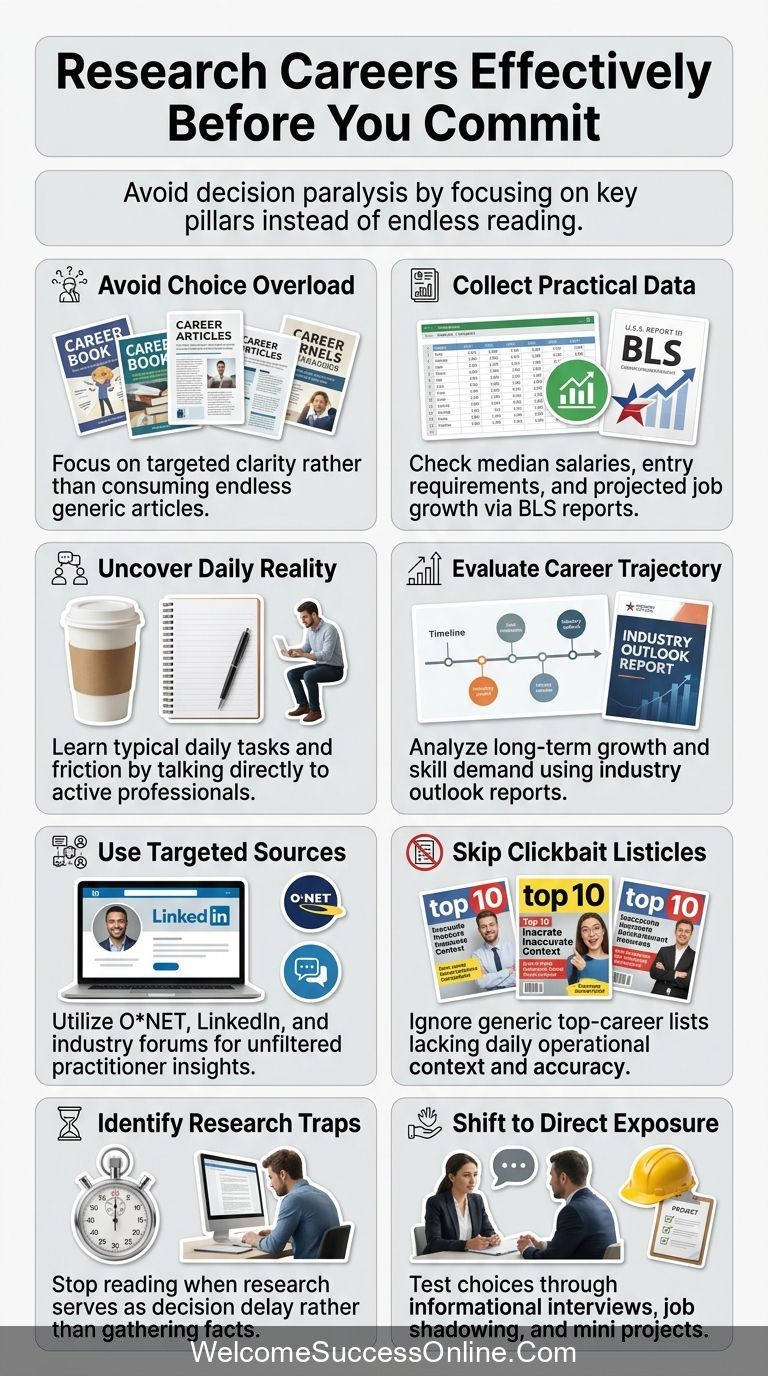
Research on choice overload consistently shows that more options and more information tend to increase decision paralysis rather than reduce it, once you cross a fairly low threshold.
Career research runs into this constantly—ten more articles rarely produce ten times the clarity.
The fix isn’t reading less. It’s about being deliberate about what you’re trying to learn, so you don’t just accumulate information for its own sake.
–
–
The Three Things Worth Actually Researching
Almost everything worth knowing about a career option falls into one of three categories.
Most people over-research the first and barely touch the other two.
1. The practical data
Salary ranges (entry-level through senior), typical education or certification requirements, and projected job growth over the next decade.
This is the easiest information to find and the least likely to actually change your mind — but it matters for ruling out options that are structurally unworkable for your situation.
The U.S. Bureau of Labor Statistics Occupational Outlook Handbook is the most complete free source for this.
For hundreds of occupations, it lists median pay, typical entry requirements, and a 10-year growth projection — all pulled from government labor data, not estimates.
2. The daily reality
What does a typical Tuesday actually look like?
What’s the ratio of the interesting parts of the job to the administrative, repetitive, or frustrating parts?
This is the information job postings and “top careers” listicles almost never include, because it isn’t flattering or easy to summarize.
The only reliable way to get this is by talking directly to people already doing the work—which is covered in its own post in this series, since it’s important enough to deserve full attention on its own.
3. The trajectory
Where does this role lead in five or ten years?
Is there a clear path upward, or does it plateau quickly?
A career that looks appealing at the entry level can look very different once you account for where it actually goes—or doesn’t.
The World Economic Forum’s Future of Jobs report is a useful cross-check here—it tracks which skills and roles are expected to grow or shrink across industries over the coming years, which helps you sanity-check whether a path has real runway.
Try This Now Pick one career option you’re considering. Write down what you already know across all three categories above—practical data, daily reality, and trajectory. Whichever category is blank is where your research is actually missing something. |
–
–
Where to Actually Look
A short, genuinely useful list — not a link dump:
- BLS Occupational Outlook Handbook — salary, growth, and requirements, straight from government data
- O*NET Online—detailed task lists and skill requirements for specific occupations, useful for comparing what a role actually involves day-to-day
- LinkedIn — not for job postings, but for finding real people in the role to reach out to directly
- Industry-specific publications or communities — the unfiltered version of what practitioners actually talk about, complaints included
Skip generic “top 10 careers” listicles almost entirely. They’re written for search traffic, not for accuracy, and they rarely reflect what the work is actually like.
The Research Trap: When Research Becomes Avoidance
There’s a point where more research stops adding real information and starts functioning as a way to delay a decision while feeling productive.
If you’ve read more than a handful of sources on the same option and still feel just as uncertain as when you started, that’s usually the signal you’ve crossed it.
The way out isn’t more reading.
It’s moving from research into direct exposure—informational interviews, shadowing, or small test projects—which is where the next posts in this series pick up.
Not Sure Which Career to Research Yet? If you’re still narrowing down what’s even worth researching, the free Career Clarity Starter Kit is a fast way to surface a real starting point—five questions that point you toward a direction worth investigating properly. |
Conclusion
Good career research isn’t about volume — it’s about covering the right three areas: the practical data, the daily reality, and the trajectory.
Most people focus too much on the first area and completely skip the other two, which is why research alone rarely produces real clarity.
Once you’ve covered all three for a shortlist of options, you’re no longer guessing—you have enough real information to move into direct exposure and testing, which is where the clearest signal actually comes from.
Frequently Asked Questions
1. How much research is actually enough before I decide?
You need enough real information across all three categories — practical data, daily reality, and trajectory — for your top two or three options.
Once you have that, further research tends to produce diminishing returns; direct exposure becomes more valuable than more reading.
2. Are online reviews and forums (like Reddit) a reliable source?
They’re useful for daily-reality texture but skew toward extremes—people tend to post when they’re especially frustrated or especially thrilled, not when things are simply fine.
Treat them as one data point among several, not the full picture.
3. What if the data (salary and growth) look great, but I still feel unsure?
That’s a signal worth taking seriously.
The practical data is the easiest category to satisfy and the least emotionally informative—uncertainty that persists after the numbers check out usually means the daily-reality or trajectory categories still need real attention.
4. Is it possible to over-research and never actually decide?
Yes, and it’s more common than people expect.
If you’ve researched the same option extensively and feel no clearer than when you started, that’s the point to shift from reading to direct exposure—a single informational interview often produces more clarity than another week of articles.
Ready to Go From Research to Real Direction?
The Career Clarity Bundle: Find Your Path in 7 Days gives you a structured way to turn everything you learn—through research and direct exposure—into an actual committed decision, not just a longer list of options.
Download it here → Career Clarity — Find Your Path in 7 Days
If you’re not there yet, start with the free Career Clarity Starter Kit—five questions that give you a real first read on your direction.