

If you don’t know what career to choose, you’re not alone — and you’re not behind.
You’ve probably spent hours thinking about different options.
Maybe you’ve Googled “what career is right for me?” a dozen times, scrolled through job listings feeling nothing, or watched friends seem to have it all figured out while you’re still stuck at square one.
Here’s the honest truth most career advice misses:
Clarity doesn’t come from thinking more. It comes from structured action.
According to the National Center for Education Statistics, roughly 80% of college students change their major at least once, and the U.S. Bureau of Labor Statistics reports that the average worker holds around 12 different jobs in their lifetime.
Career decisions rarely happen in one moment. They evolve.
So if you feel lost right now? You’re not broken. You’re just in the decision phase.
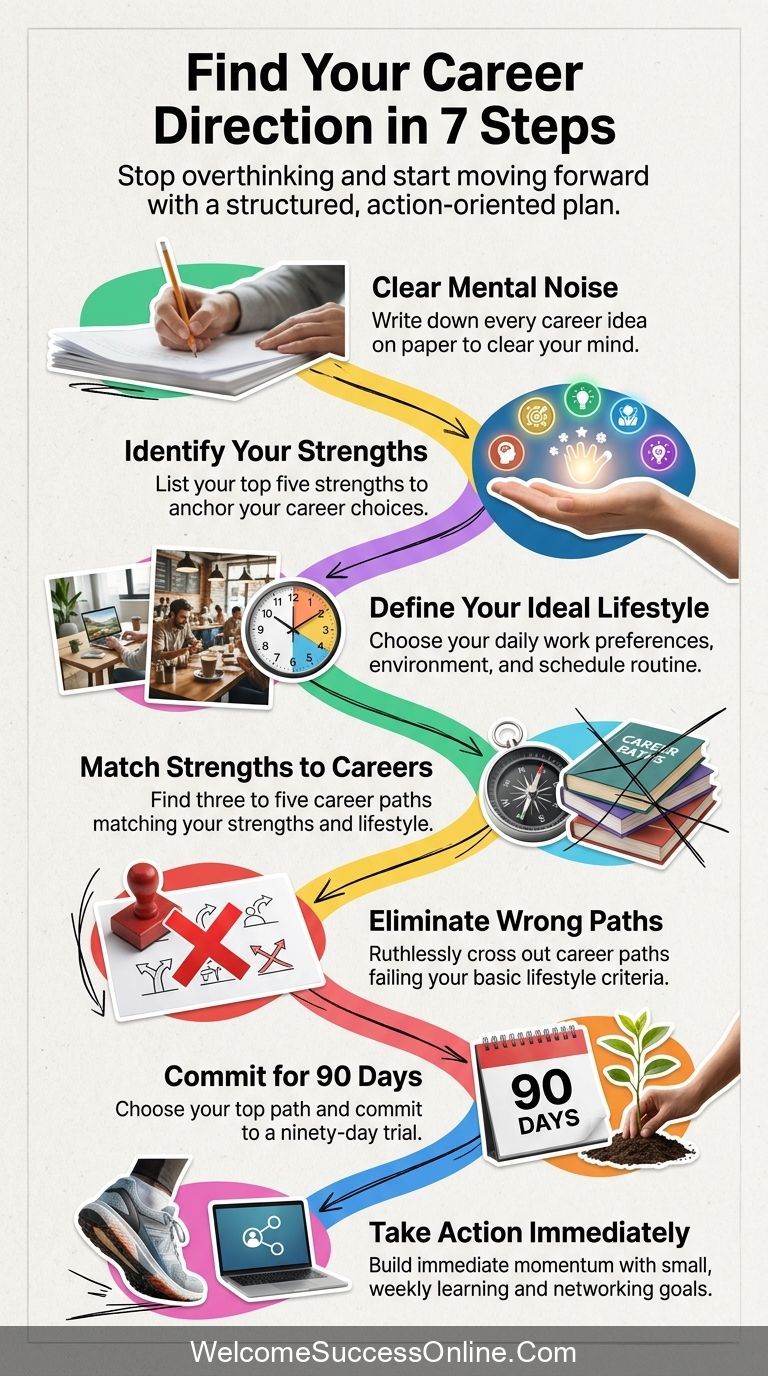
This guide walks you through a clear, 7-step process that combines self-assessment, career exploration, and practical decision-making — so you can stop overthinking and start moving in a direction that actually fits you.
Why You Feel Stuck Choosing a Career
Before we jump in, let’s name what’s actually happening.
Most people struggle with career decisions because they:
- Try to find the “perfect” career before taking any action
- Overthink every option until every path seems wrong
- Follow what others expect — parents, society, social media
- Ignore their own strengths and lifestyle preferences
- Wait for clarity to arrive before doing anything
This is what psychologists call decision paralysis — the more options we perceive, the harder it becomes to choose any of them.
The solution isn’t more research. It’s a structured process that narrows your focus one step at a time.
Before you keep reading—grab the free Starter Kit below and start applying this as you go.
The goal of this guide isn’t to hand you a perfect career. It’s to give you a system to find your direction—one step at a time.
–
–
Step 1: Clear the Mental Noise
Most people are stuck because they’re overwhelmed — not because they lack options.
Their minds are flooded with too many possibilities, half-formed ideas, and external expectations.
So the first step is deceptively simple:
Exercise: The Everything Dump
Write down every career idea you’ve ever considered. Include unrealistic ones, old ones, ones you dismissed, ones you’re embarrassed about. No filtering. No judgment.
Then go through the list and circle anything that still interests you — even slightly.
Why this works:
- It gets the noise out of your head and onto paper
- You start to see patterns you couldn’t see before
- It immediately reduces the overwhelm that keeps you frozen
This one exercise alone can shift your thinking. Don’t skip it.
Step 2: Identify Your Strengths
A good career doesn’t fight your natural strengths — it uses them. Yet most people skip this step and jump straight to job titles.
Exercise: Your Top 5 Strengths
Answer these honestly:
- What do people usually ask me for help with?
- What feels easier for me than it does for others?
- What have I improved at quickly in the past?
- What kinds of tasks make me lose track of time?
Write down your top 5 strengths. These are your anchors — every career option you consider should connect back to at least one of them.
For a more structured self-assessment, tools like the O*NET Interest Profiler (free, from the U.S.
(Department of Labor) The VIA Character Strengths Survey can help you identify patterns you might not see on your own.
Strengths fall into three broad categories:
- Technical skills—specific knowledge or abilities (writing, coding, design, analysis)
- Thinking skills—problem-solving, creativity, logical reasoning
- People skills—communication, leadership, teaching, persuasion
Knowing which category you’re strongest in already narrows your options significantly.
Step 3: Define Your Ideal Work Life
This is where most people go wrong.
They choose a career based on salary or status — without thinking about how they actually want to live day to day.
Your career should support your lifestyle, not control it.
Exercise: Your Work Style Preferences
Choose your honest preference in each area:
- Remote work vs. office environment
- Stable routine vs. flexible schedule
- Solo work vs. team collaboration
- High income vs. lower stress
- Structured tasks vs. creative freedom
Then write this sentence and complete it:
“My ideal work life looks like ___________.”
A landmark Gallup workplace study found that work-life balance and personal well-being have overtaken compensation as the number one factor people consider when choosing a job.
Your lifestyle preferences aren’t a luxury—they’re a core part of choosing the right direction.
–
Step 4: Match Yourself to Career Paths
Now you have the ingredients. It’s time to combine them.
Exercise: The 3-Column Match
Create three columns on a page:
Strengths | Interests | Work Style Preferences
Fill in each column from your previous exercises. Then ask:
“What careers match all three columns?”
List 3 to 5 possible career paths that intersect. Don’t evaluate them yet — just generate options.
To research what those careers actually involve day-to-day—including salary ranges, job outlooks, and required education—the U.S. Bureau of Labor Statistics Occupational Outlook Handbook is one of the most authoritative free resources available.
Use it to ground your options in real data.
💡 Feeling overwhelmed already?
Don’t worry—you don’t have to figure this out alone.
I created a simple step-by-step system that walks you through this entire process in just 7 days.
–
👉 Want a structured step-by-step version?
–
Step 5: Eliminate the Wrong Paths
This step is underrated — but it’s one of the most powerful things you can do for your clarity.
Most people try to find the right path. The faster move is eliminating the wrong ones.
Exercise: The Elimination Test
For each option on your list, ask these three questions:
- Do I actually enjoy this — or do I just like the idea of it?
- Does this match my lifestyle preferences?
- Am I genuinely willing to learn and grow in this field for 6 to 12 months?
Cross out anything that doesn’t pass all three. Be ruthless.
You should finish this exercise with 1 to 2 solid options. That’s exactly where you want to be.
Eliminating confusion is clarity. Don’t be afraid to cut.
Step 6: Make a Clear Decision
This is the step where most people get stuck the longest. They keep researching, comparing, and waiting for certainty that never comes.
Here’s the truth: you will never have 100% certainty before you start. Certainty comes after you begin.
Exercise: Commit for 90 Days
Pick your top option and answer these questions in writing:
- Why am I choosing this path over the others?
- What genuinely excites me about it?
- What’s holding me back—and is that fear valid?
Then write this commitment:
“For the next 90 days, I will focus on ___________.”
Not forever. Not a lifetime commitment. Just 90 days of focused exploration.
As Harvard Business Review research on career decision-making consistently shows, engagement with work develops passion and clarity, rather than discovering them beforehand.
Making a committed start generates certainty; it is not a prerequisite for it.
Step 7: Take Action Immediately
Clarity only comes when you start moving.
Reading about careers will never give you the certainty that doing so does.
Exercise: Your Simple First-Week Plan
Create a basic action plan with three levels:
- Learn – Find – one quality resource (course, YouTube channel, book, podcast) in your chosen field and start today
- Practice – Identify one small project you can work on in the next 7 days, even if it’s just 30 minutes
- Connect – Reach out to one person already working in this field for an informational conversation
Then answer:
- What will I do this week?
- What will I do tomorrow?
Keep it small and realistic. The goal isn’t a grand plan — it’s a first step you’ll actually take.
Platforms like LinkedIn and Coursera offer free introductory courses across hundreds of career fields — a low-risk way to test real interest before making a bigger commitment.
Clarity comes from action, not thinking. The map appears as you walk.
What the Research Actually Says
This process isn’t just intuition—it’s backed by how career decisions actually work in the real world:
- 80% of college students change their major at least once—National Center for Education Statistics—showing that career direction naturally evolves over time.
- The average worker holds 12 jobs in a lifetime—U.S. Bureau of Labor Statistics—career shifts are the norm, not the exception.
- 63% of interns from the 2024–2025 cohort received full-time job offers—NACE 2026 Internship & Co-op Survey—making real-world experience the most direct path to employment.
- 70–85% of all job positions are filled through networking rather than public job boards (LinkedIn Workforce Report); who you know matters enormously.
- Referred candidates have a 30–40% interview conversion rate compared to just 2–5% for cold applications — SHRM research on employee referrals.
The data tells a consistent story: people who take structured, action-oriented steps — even imperfect ones — end up more satisfied than those who wait for perfect clarity before moving.
Overcoming the Most Common Roadblocks
“What if I choose the wrong career?”
This fear keeps more people stuck than any other obstacle. But consider this: most people don’t end up with the career they first imagined.
They find something better through exploration, experience, and adjustment.
A McKinsey & Company report on workforce transitions found that career pivots are not only common but also increasingly expected as industries evolve.
Making one focused choice now doesn’t close other doors. It opens the first one.
“My parents or family expect something different from me.”
Family pressure is real. The pull to meet other people’s expectations is hardwired into us.
But choosing a career to make others happy — while ignoring your own strengths and interests — rarely ends well for anyone involved.
You can honor your family’s values (hard work, stability, contribution) without copying their specific career path.
Show them a plan. Show them the research. Demonstrate commitment. Most families come around when they see you’re serious, not just dreaming.
“I don’t have the resources or connections.”
Limited resources are a real challenge—but they’re rarely as total as they feel.
Free tools like the O*NET Online career database, Khan Academy, and MIT OpenCourseWare make world-class learning available to anyone with an internet connection.
Volunteer work, freelance projects, and informational interviews can substitute for expensive programs or elite networks.
The most important resource you have right now is the willingness to start.
That’s what separates people who find direction from people who stay stuck.
Ready to Get Serious About Your Direction?
Reading this guide is a great starting point. But let’s be honest — knowledge without action doesn’t create change.
If you’re ready to stop guessing and start building real career clarity, I’ve created a complete, step-by-step system that walks you through every exercise in this guide and more:
Career Clarity in 7 Days
A simple, practical PDF guide to help you discover your strengths, identify the right career paths, eliminate confusion, and build a clear action plan—in just one week.
Inside the guide, you’ll find:
- Day-by-day exercises with clear instructions — no guesswork
- Worksheets to help you identify your strengths, values, and lifestyle preferences
- A career matching system that connects who you are to what’s possible
- An elimination framework to cut confusion fast
- A 90-day action plan template to move forward with confidence
👉 Get Career Clarity in 7 Days — Download the Guide
–
Not ready to buy yet?
Start with the Career Clarity Starter Kit on the site—it gives you an instant snapshot of where you are and what direction might fit you best.
Final Thoughts: Stop Waiting for Permission to Move Forward
You’re not stuck because you’re incapable.
You’re stuck because you’ve been trying to figure everything out in your head—alone, without a system, without structured steps.
Now you have a better way.
The 7-step process in this guide isn’t magic. It won’t eliminate all uncertainty.
But it will move you from confusion to clarity faster than any amount of additional thinking ever could.
Here’s your reminder of the full process:
- Clear the mental noise—dump every idea onto paper
- Identify your strengths—know what you naturally bring
- Define your ideal work-life—career should fit your lifestyle
- Match yourself to career paths—find the intersections
- Eliminate the wrong paths—clarity through subtraction
- Make a decision — commit to 90 days, not forever
- Take action immediately—start today, even if it’s small
Clarity comes from action, not from thinking. Take the first step.
And if you want a complete, structured system to walk through every step — with worksheets and exercises built in — grab the Career Clarity in 7 Days guide at WelcomeSuccessOnline.com.
👉 Start Your Career Clarity Journey at WelcomeSuccessOnline.com
Frequently Asked Questions
Why do people struggle to choose a career?
Most people get stuck trying to find the “perfect” path before taking any action. Psychology Today notes that decision paralysis intensifies as the number of perceived options grows.
Career clarity comes from structured exploration, not from finding a perfect answer in your head.
What is the first step when I don’t know what career to choose?
The first step is clearing the mental clutter — writing down every career idea you’ve ever considered, no matter how unrealistic, then identifying which ones still hold any interest for you.
This simple exercise immediately cuts through overwhelm.
What free tools can help me explore careers?
Several free tools are worth using: the O*NET Interest Profiler from the U.S.
Department of Labor, the BLS Occupational Outlook Handbook for job data and salary ranges, and the VIA Character Strengths Survey for understanding your natural strengths — all completely free.
Should I choose a career based on money or passion?
Neither extreme works well on its own. Pew Research Center findings and behavioral economics research both suggest that after a reasonable income threshold, additional salary contributes little to day-to-day satisfaction—while genuine engagement at work remains the strongest predictor of career fulfillment.
The best direction sits where reasonable income meets real interest.
Is it normal to change careers multiple times?
Completely. The U.S. Bureau of Labor Statistics reports the average worker holds 12 different jobs in their lifetime, with a median job tenure of just 3.9 years.
Career paths are not linear — they evolve as you grow, learn, and discover new opportunities.
What matters most is having a system to navigate each transition clearly.
Refer to my guide on [What Career Is Right for Me? A No-Guesswork Method to Find Your Answer]
WelcomeSuccessOnline.com | Career Direction
Helping you find direction — with clarity, not confusion.
7 thoughts on “I Don’t Know What Career to Choose: 7 Step Guide to Find Your Direction”
Comments are closed.