

Most people don’t choose a career. They fall into one.
They take whatever opportunity shows up at the right time.
Follow the path their family expected, or pick the field that seems stable and never look back—until years later when they’re sitting at a desk, wondering how they ended up here.
If you’re asking, “What career is right for me?”—genuinely asking, not just browsing—that’s actually a good sign. It means you haven’t settled yet.
You’re still willing to make a deliberate choice.
The problem is that most of the advice out there is either too vague (“follow your passion!”) or too mechanical (“take this quiz and get your answer”). Neither works particularly well.
This guide sits in between.
It’s built on a structured process—the same kind I’ve walked people through for years—that gives you real clarity, not just a list of suggested job titles.
By the end, you won’t just have an answer.
You’ll know why that answer is the right one for you.
Why Most People Get This Wrong From the Start
The standard approach to choosing a career usually goes like this: think about what you enjoy, research jobs that match, and pick one.
Simple enough on paper. But it leaves out several factors that actually determine whether a career works for you in the long term.
It ignores how you want to live.
A career isn’t just a job—it’s a daily structure. It affects your schedule, your energy, your stress levels, and your relationships.
Two people can hold the same job title but have very different experiences depending on where they work, who they work for, and how the role is scoped.
It assumes passion is fixed.
The idea that you have one true passion waiting to be discovered puts enormous pressure on a single decision.
Research by organizational psychologist Adam Grant and others suggests that passion often follows competence — you get good at something, and the enjoyment grows from there.
So waiting to “feel” the right answer before acting usually keeps people stuck.
It skips the elimination step.
Most frameworks focus on finding the right option. Far fewer focus on systematically removing the wrong ones.
That second part is often what actually produces clarity.
A better approach starts with a different question. Not “what career should I choose?” but “what information do I need to make a decision I can actually commit to?”
Before you dive into the steps below — grab the free Starter Kit to start applying this as you go.
–
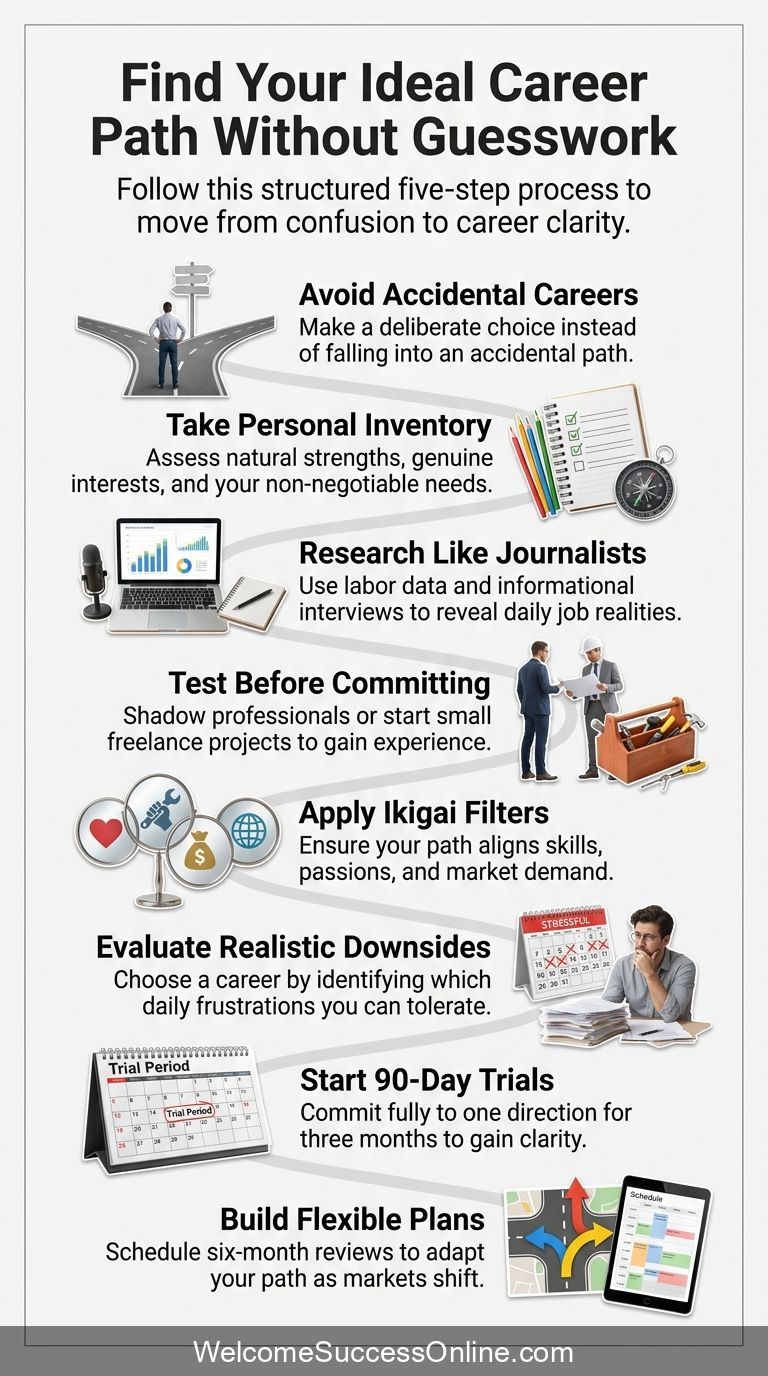
Step 1: Take an Honest Personal Inventory
Before researching any career options, you need a clear picture of yourself. Not who you want to be — who you actually are right now.
This is the foundation everything else builds on.
There are four things worth assessing:
Your Natural Strengths
These are abilities that show up without much effort—things you pick up quickly, do consistently well, and that other people notice.
Not necessarily what you’ve studied or been trained in, but what comes naturally.
A useful question: what do people regularly ask you for help with, even outside a professional context?
The answers reveal real strengths, because people rarely ask for help with things someone isn’t genuinely good at.
If you want a structured tool, the CliftonStrengths assessment (formerly StrengthsFinder) is one of the more useful ones for identifying natural talent patterns.
It’s not free, but it goes deeper than most free quizzes.
Your Genuine Interests
Not what sounds impressive, not what your parents value, not what your friends are doing.
What actually holds your attention when nobody is watching?
Think about what you read about voluntarily, what topics pull you into YouTube rabbit holes, and what work you’d find yourself doing even if you weren’t being paid.
These are signals worth paying attention to.
The O*NET Interest Profiler (free, from the US Department of Labor) maps your interests to career categories using the Holland Code framework.
It’s a solid starting point for people who feel genuinely uncertain.
Your Non-Negotiables
Every person has certain conditions that, if violated, make them miserable in a job, regardless of how well it pays or how much status it carries.
Be honest about yours.
- Do you need autonomy over your schedule, or do you prefer clear structure?
- Do you work better alone, in small teams, or in large collaborative environments?
- Is location flexibility important—remote work, ability to travel, staying close to family?
- What income floor do you need to live the life you want, without financial stress?
- How much do you need your work to feel meaningful versus it being a means to fund the rest of your life?
Write these down before moving on.
They become filters that eliminate career options automatically — which saves a significant amount of time later.
Your Transferable Skills
If you’ve already been working in any field, you’ve built skills that cross industry lines.
Communication, information organization, people management, problem-solving, clear explanation of complex ideas, and project coordination.
These matters are more than most people realize when changing direction.
List them explicitly. Don’t assume they’re obvious or that employers will infer them.
When you make them visible to yourself, you can spot which career paths you’re already partially equipped for.
Step 2: Research Careers Like a Journalist, Not a Daydreamer
This is where most people either skip straight to job postings (too narrow) or spend hours on “top careers” listicles (too generic).
There’s a better way.
Use the Bureau of Labor Statistics Occupational Outlook Handbook
The BLS Occupational Outlook Handbook is one of the most underused career research tools available, and it’s completely free.
For hundreds of occupations, it shows you typical daily duties, required education and training, median annual salary, projected job growth over the next decade, and the industries that employ the most workers in that field.
Don’t just look at the salary number. Pay attention to the job growth projections — they tell you whether you’re entering an expanding field or a shrinking one.
Go Beyond the Job Description
Job postings describe what employers want.
They don’t describe what the job actually feels like from the inside.
For that, you need to talk to people doing the work. Informational interviews — short, informal conversations with professionals in a field you’re considering — are the single most valuable research tool available.
Most people don’t use them because asking feels awkward.
But professionals in most fields are surprisingly willing to spend 20 minutes talking about their work, especially when the request is specific and genuine.
Ask about the parts of the job that don’t show up in descriptions: the administrative overhead, the politics, the biggest sources of frustration, and what separates people who thrive in the role from those who don’t.
Career Comparison: What to Actually Look At
| Research Factor | Where to Find It | Why It Matters | Red Flags | Green Flags |
| Daily duties | Informational interviews, day-in-the-life videos | Reveals actual work vs assumed | Tasks you’d dread daily | Work you’d do regardless of pay |
| Salary range (entry to senior) | BLS, Glassdoor, Payscale | Sets realistic expectations | Wide gap with no clear path up | Steady growth trajectory |
| Job growth projection | BLS Outlook Handbook | Signals long-term viability | Declining or flat projections | 10%+ growth forecast |
| Entry requirements | Job postings, industry associations | Shows time/cost to get in | Years of unpaid training | Accessible entry points exist |
| Work environment & culture | LinkedIn, employee reviews on Glassdoor | Affects day-to-day quality of life | High burnout rates reported | People stay long-term willingly |
Step 3: Test Before You Commit
Reading about a career and doing it are completely different experiences.
Before making a major commitment — going back to school, taking a pay cut to switch fields, or investing months in retraining — find a way to test the work in some form.
Informational Shadowing
Ask to shadow someone in a role for a day or two. Not to get hired — just to observe. Watch what a typical morning looks like.
Notice what they spend most of their time on.
Pay attention to the energy in the room and how they talk about their work at 3 pm versus 9 am.
One or two days of observation give you more useful information than weeks of online research.
Freelance or Project-Based Testing
Many career paths have a freelance or side-project equivalent that lets you test the actual work before committing.
If you’re considering marketing, take on a small project for a local business or nonprofit.
If you’re considering UX design, work through a self-directed project and show it to people in the field for feedback.
If you’re drawn to consulting, offer your current expertise to one client on a limited basis.
The goal isn’t to build a full freelance business.
It’s to answer one question: what does it feel like to actually do this work, and do I want more of it?
Short Courses and Certifications
Platforms like Coursera, LinkedIn Learning, and industry-specific training programs let you spend 10–20 hours genuinely engaging with a field before making larger commitments.
This isn’t about getting certified for a resume — it’s about learning enough to know whether you actually enjoy the subject matter.
Step 4: Run a Structured Decision Process
By this point, you should have a shortlist—probably two to four options that have survived initial research and at least some real-world exposure.
Now it’s time to actually decide.
The Ikigai Filter
The Japanese concept of Ikigai—roughly translated as “reason for being”—maps career fit across four questions: What are you good at?
What do you genuinely enjoy? What does the world need? What can you be paid for? A career that satisfies all four tends to produce lasting engagement.
A career that only hits two or three will eventually produce a gap that’s hard to ignore.
Run each of your shortlisted options through these four questions honestly. Not aspirationally — honestly.
The gaps you identify now are far less costly than the gaps you discover three years in.
The Upside-Downside Analysis
For each remaining option, write two columns: realistic upsides and realistic downsides.
Not worst-case scenarios—realistic ones, based on what you’ve learned through research and conversations.
Then ask yourself: Which downsides am I actually willing to live with?
This is often where the real decision gets made. Most people know which option they prefer.
What they don’t know is whether they can accept the costs that come with it.
Getting specific about the costs makes that question answerable.
The 90-Day Commitment Test
Before treating any decision as final, apply this test: can I commit to this direction for 90 days of genuine effort—not just passive interest but actual work toward it?
If the answer is yes, you have your direction. Write it down.
Not in your head — write it down on paper. “For the next 90 days, I am focusing on [career direction].”
That specificity creates a different kind of commitment than keeping the decision floating in your mind.
If the answer is no, that’s also useful information.
Go back to your shortlist and find the option in which the 90-day commitment feels feasible.
Step 5: Build a Career Plan That Can Bend
A career plan doesn’t need to be a five-year roadmap.
In fact, detailed five-year plans often become an obstacle—people cling to them long after they’re no longer accurate.
What you need instead is a three-tier structure:
Your Primary Path (Next 90 Days)
What are you specifically doing to move toward your chosen direction in the next 90 days?
Break it into three categories:
- Learn: What do you need to understand about this field that you don’t know yet? Pick two resources and start the first one this week.
- Practice: What’s the smallest version of this work you can start doing now, even without being paid for it?
- Connect: Who are three people already working in this field that you could have a conversation with in the next month?
Your Backup Option (Plan B)
Identify one alternative direction that could work if your primary path hits a genuine obstacle — not a bump, but a real structural problem.
This isn’t defeatism. It’s the difference between a setback that derails you completely and one that requires an adjustment.
Your Review Points
Schedule a career review every six months.
Block it in your calendar now. At each review, ask three questions:
Has my direction proven to be a fit, or have I learned something that changes it?
Are my skills moving in the right direction?
Is the external environment—job market, industry trends—still pointing the same way it was?
Career markets shift.
The World Economic Forum’s Future of Jobs report consistently identifies skills in technology, analytical thinking, and interpersonal communication as increasingly valuable across sectors.
Checking in regularly keeps you aligned with where demand is actually heading.
–
–
What to Do When You’re Still Stuck After All of This
Some people work through every step above and still feel uncertain.
That’s not a failure of the process — it usually signals one of three things:
- You’re holding out for certainty that won’t arrive until after you start. Clarity comes from action more than from planning. The decision itself won’t feel completely right until you’re inside it.
- You’re afraid of choosing wrong. A wrong choice isn’t the disaster it feels like. It’s information — useful, correctable information. Every career move teaches you something about what actually suits you.
- You need more real-world exposure before deciding. If you haven’t talked to anyone in your shortlisted fields, done any test projects, or shadowed anyone, go do that before sitting with the decision longer.
If none of those apply and you’ve genuinely done the work, here’s what I’d suggest: pick the option that satisfies the most of your non-negotiables and commit to it for 90 days.
Real-world experience will tell you more than another month of deliberation.
Frequently Asked Questions
How do I choose a career if I have no idea what I’m interested in?
Start with strengths rather than interests. What do you do well?
What do others ask for your help with?
Competence often generates interest over time—meaning you may not need to start from a place of passion.
Identify two or three things you’re genuinely capable of and research what careers those skills support.
Is it too late to change careers if I’m already mid-career?
Career transitions happen at every stage, including in people’s 40s and 50s. The more useful question is whether your existing skills transfer—and they almost always transfer more than you expect.
Experience in one field (management, communication, analytical thinking, or client work) translates across sectors.
The main adjustment is usually being willing to enter a new field at a slightly junior level initially.
Should I prioritize salary or job satisfaction?
Both matter, and treating them as opposites is usually a mistake.
Research by Princeton economist Angus Deaton suggests that income affects well-being, but only up to the point where financial stress is lifted.
Beyond that threshold, the work itself has a stronger influence on day-to-day satisfaction.
A practical approach: identify your income floor (what you genuinely need, not what would be nice) and then optimize for satisfaction within fields that meet it.
What if I’m interested in more than one career path?
Narrow it using the elimination questions in Step 4.
If two options genuinely pass every filter, choose one and commit to the 90-day trial.
You’re not closing a door permanently—you’re making a testable decision.
Most people find that one path naturally pulls ahead once they’re actually inside it rather than just thinking about it.
Do personality tests actually help with career decisions?
They help as a starting point, not as a final answer.
Tools like the Big Five personality assessment or Holland Code interest inventories can surface patterns you haven’t consciously noticed.
But they work best when used as one input alongside real-world research and genuine self-reflection — not as a substitute for those things.
For a deeper dive, check out my guide on [I Don’t Know What Career to Choose: 7 Step Guide to Find Your Direction]
Ready to Put This Into Practice?
Reading about the process is one thing. Working through it is another.
The Career Clarity — Find Your Path in 7 Days guide walks you through a structured 7-day process with exercises designed to get you from confusion to a clear, committed direction.
2 thoughts on “What Career Is Right for Me? A No-Guesswork Method to Find Your Answer”
Comments are closed.