
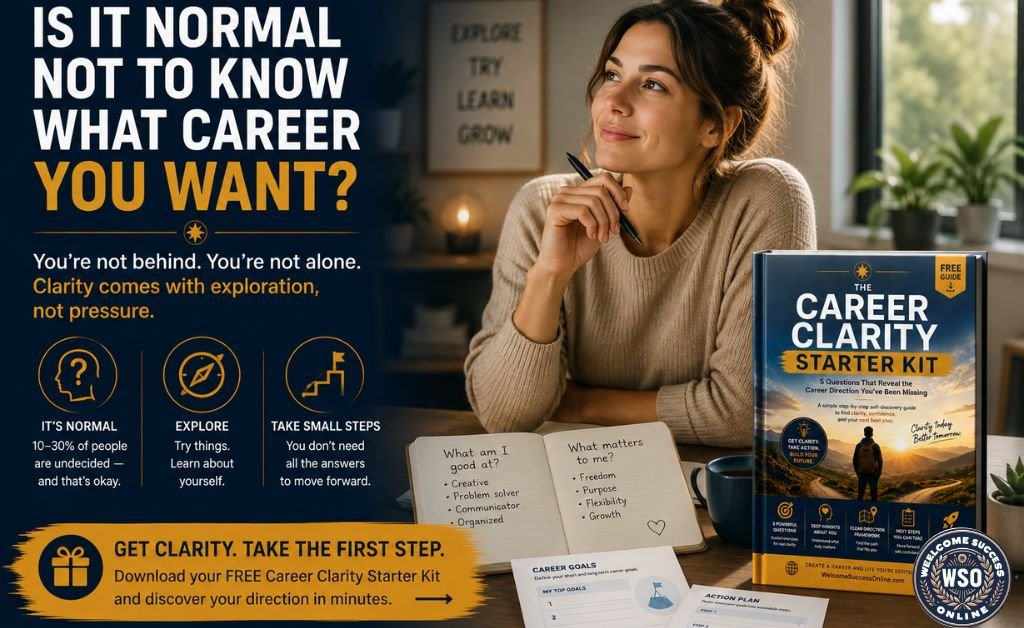
Is it normal to not know what career you want? Short answer: yes. Genuinely, overwhelmingly yes.
But knowing this intellectually doesn’t always make the feeling go away—especially when everyone around you seems to have it figured out, and you’re still unsure what you’re doing.
Here’s why not knowing is so much more common than it feels, why it feels worse than it actually is, and what helps beyond just waiting for clarity to show up.
–
–
Why Not Knowing Is So Common
Most people don’t have one clear calling waiting to be discovered—clarity tends to get built through experience, not handed over in a single moment of insight.
Career indecision has been studied since the 1930s, and it’s consistently found to be a normal, common stage rather than a sign that something’s wrong.
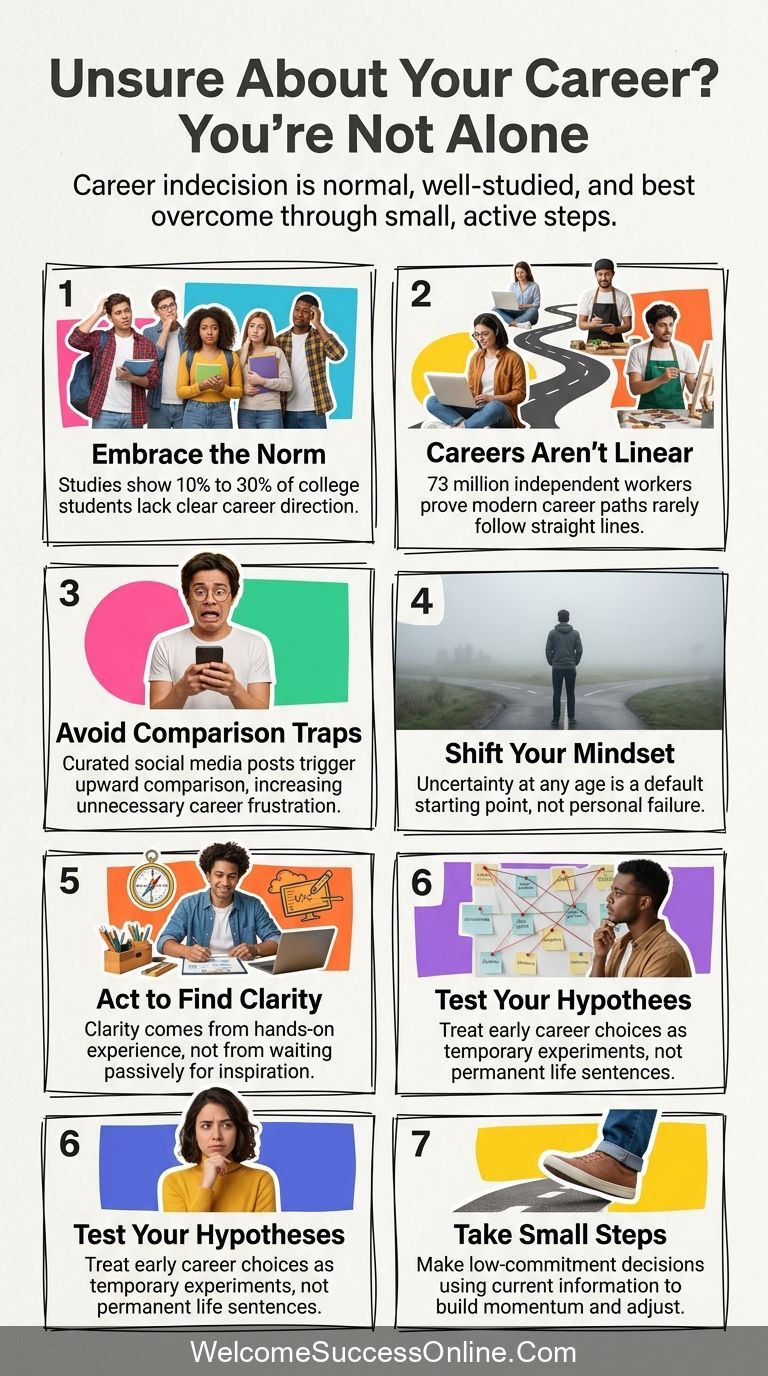
Research summarized by career development scholars puts the share of undecided college students at roughly 10 to 30 percent, describing indecision as a “normative phenomenon” tied to age and stage rather than a personal failing.
On top of that, career paths themselves are less linear than they used to be, which removes a lot of the old certainty about what a “normal” path even looks like.
Independent, freelance, and fractional work has grown substantially in recent years—one recent report counted nearly 73 million independent workers
Why It Feels Worse Than It Is
Social media makes this worse in a specific, measurable way. Seeing a peer’s promotion or big career update triggers an automatic internal comparison—where am I compared to them, and am I behind?
A study published in peer-reviewed research on social media and career comparison found that viewing other people’s career-related posts triggers upward social comparison, which directly increases career frustration—even among people whose own careers were otherwise going fine.
| Reminder: Not knowing your career direction at 22, 30, or 45 is not a personal failure—it’s the default starting point most people just don’t talk about. |
–
–
What you’re seeing on a feed is a highlight reel, not the full story.
The uncertainty you’re feeling privately is something most people carry too—they just don’t post about it.
What Actually Helps (Beyond Waiting for Clarity)
Active exploration beats passive waiting. Clarity tends to come from trying things, not as a precondition for trying them.
Small, structured decisions now beat waiting for total certainty.
You don’t need to feel 100% sure to take a reasonable next step—you need enough information to take a small one, then adjust based on what you learn.
And it helps to treat your first real career choice as a hypothesis worth testing, not a life sentence.
Given how common it is to change direction over time, that framing is simply more accurate than treating this one decision as permanent.
Not knowing yet doesn’t mean you’re stuck—it means you haven’t taken a small first step. The free Career Clarity Starter Kit is a gentle, low-commitment way to start.
Conclusion
Lacking a clear career goal is not a personal failing — it’s the normal, well-documented starting point most people quietly share and rarely talk about.
Career indecision has been studied for nearly a century, and it consistently shows up as a stage people move through, not a flaw in the people experiencing it.
What makes it feel worse than it actually is has less to do with the uncertainty itself and more to do with comparison—watching curated highlight reels of other people’s progress and mistaking that for the full picture of where everyone else stands.
The way through isn’t waiting for a moment of total clarity to arrive before you act. It’s treating your first real choice as a hypothesis worth testing rather than a life sentence and taking one small, structured step even without full certainty.
Clarity tends to follow action, not the other way around.
Frequently Asked Questions
1. Is it actually normal not to know what career I want in my 30s or 40s?
Yes.
Career paths have become significantly less linear in recent years, with independent, freelance, and fractional work growing substantially—which means there’s less of a single “normal” trajectory to be behind on than there used to be, at any age.
2. Why does social media make career uncertainty feel worse?
Seeing peers’ career updates and promotions triggers automatic upward comparison—research shows this measurably increases career frustration, even among people whose own careers are otherwise going fine.
What you’re seeing is a highlight reel, not the full picture of someone else’s uncertainty.
3. Should I wait until I feel completely sure before making a career decision?
No — waiting for total certainty tends to delay clarity rather than produce it.
Small, structured decisions made with partial information, then adjusted as you learn more, consistently work better than waiting for a certainty that rarely arrives on its own timeline.
4. What’s a reasonable first step if I genuinely have no idea where to start?
Something small and low-commitment — a short set of guided questions, one informational conversation, or a single hour of real exploration.
The goal isn’t landing on the final answer; it’s generating enough real information to take the next small step after that.
–
| Ready to Take That First Step? The Career Clarity Bundle: Find Your Path in 7 Days turns that first step into a full, guided process—one day at a time, so you’re not left figuring out what comes next on your own. – Download it here: Career Clarity — Find Your Path in 7 Days If you’re not there yet, start with the free Career Clarity Starter Kit — five questions that give you real signals in just a few minutes. |
3 thoughts on “Is It Normal Not to Know What Career You Want?”
Comments are closed.