

Two good offers sound like a good problem.
In practice, it can be a stressful one.
Both employers want an answer, both roles have real upsides, and every time you lean toward one, the other pulls you back.
If you’re trying to work out how to decide between two jobs, the instinct is to reach for the number you can compare most easily: salary.
That’s usually the weakest way to choose.
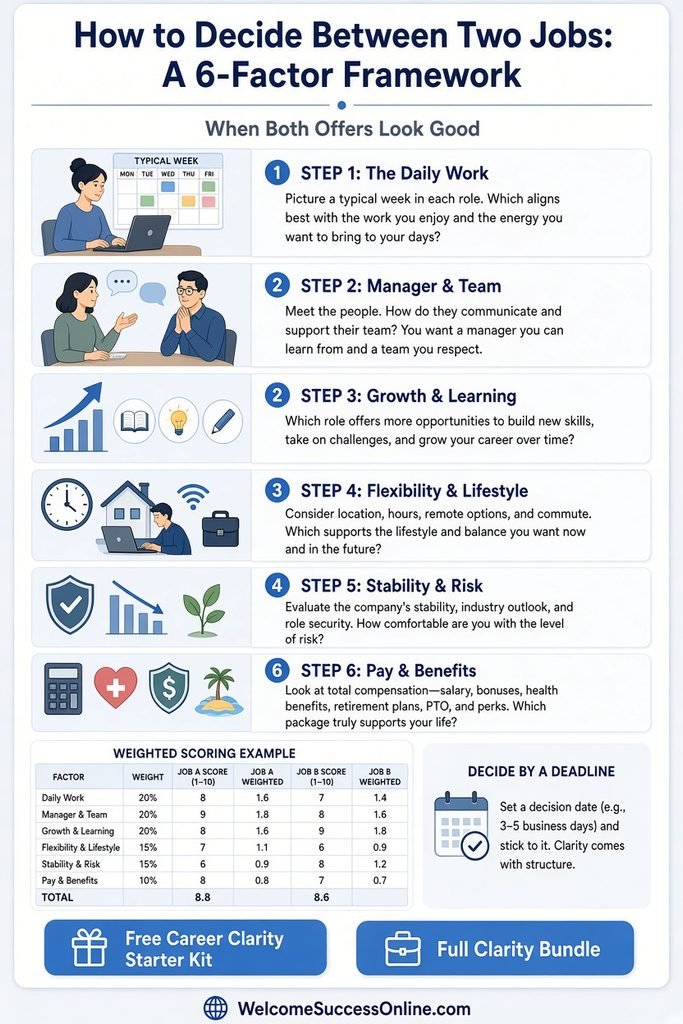
This post shows you what the research says about pay and satisfaction, then gives you a six-factor comparison you can complete in an evening, so you can choose between two job offers on evidence instead of anxiety.
.
.
Why Salary Is the Easiest and Worst Tiebreaker
Salary is the one factor that comes with a clean number, so it tends to dominate the comparison.
The other factors, such as the work itself, your manager, and how much you’ll learn, are harder to measure, so they get less weight than they deserve.
The research suggests that’s a mistake.
A meta-analysis of 92 independent samples by Timothy Judge and colleagues found that pay level correlated only weakly with job satisfaction.
15 with overall job satisfaction, which the authors describe as “only marginally related.” You can read the summary in The relationship between pay and job satisfaction: A meta-analysis of the literature.
This doesn’t mean pay doesn’t matter. It matters a great deal for meeting your needs, which is why your income floor works as a threshold.
Once both offers are clear, an extra salary tells you much less about how you’ll feel in the job than most people expect.
There’s a second trap. Psychologists Timothy Wilson and Daniel Gilbert call it focalism: focusing on one aspect of a future event and underestimating how much other factors will shape how you feel.
When you picture the bigger paycheck, you picture only the paycheck itself.
You don’t picture the commute, the manager, or the Tuesday afternoons.
Their paper, Affective Forecasting: Knowing What to Want, explains why we get these predictions wrong.
.
.
How to Decide Between Two Jobs: A 6-Factor Comparison
Answer each question for both jobs, in writing.
Wherever you’re guessing, mark it.
Those are the gaps to fill before you decide.
1. The daily work
What will you actually do on an ordinary Tuesday, and how will you make use of your strengths?
Ask the hiring manager for a typical week, not just the job description.
If you can, talk to someone who currently does the role.
Here’s how to get an informational interview and what to ask.
2. Your manager and team
Your manager shapes more of your daily experience than the company brand does.
Ask to meet the team, and ask how long people tend to stay and why they leave.
A team that speaks openly about its challenges is usually a better sign than one that only sells.
3. Growth and learning
Where will you be in two years in each role?
Ask what skills you’ll build, who gets promoted, and how.
A job that pays slightly less but builds transferable skills can be worth more over time than one that doesn’t.
4. Flexibility and lifestyle
Check hours, location, commute, remote options, and travel against your non-negotiables.
A role that looks perfect but violates one of your non-negotiables will cost you every week.
5. Stability and risk
How secure is the employer, and how much of your pay depends on performance targets?
A startup offer isn’t necessarily worse than a corporate one, but you should know what you’re accepting.
Ask how long the role has existed and why it’s open.
6. Pay and benefits
Compare total compensation, including health coverage, retirement contributions, time off, and bonuses, against your income floor.
To see whether each offer is typical for the role, check the median pay in the Bureau of Labor Statistics Occupational Outlook Handbook.
Put pay last on purpose. It’s the factor you’ll weigh without any help.
Now score each factor from 1 to 5 for each job, weight them by how much they matter to you, and total the results.
Step 4 of our career decision-making framework shows how weighted scoring works, with a worked example.
| . Try This Now For each offer, write what a normal Tuesday would look like six months in, hour by hour. The one you can describe in more specific detail is usually the one you understand better. The one you can only describe in generalities is the one to investigate before you say yes. . |
–
Not Sure What Matters Most to You? The free Career Clarity Starter Kit helps you surface your strengths and your must-haves, so your weights reflect what you actually need. Five questions that give you a clear first read. . |
When Your Head and Your Heart Disagree
If the scorecard favors one job and your gut votes for the other, don’t ignore either.
A specific reason, such as disliking the commute or wanting to work with a certain person, is a missing factor, so add it and rescore.
A vague unease is more often fear of change than a real signal.
Our guide on how to choose between two career paths covers that head-versus-heart question in more depth.
You can also use the energy-after check.
After meeting each team or spending time at each workplace, notice how you feel hours later.
We explain how to know if you’ll enjoy a job before you take it.
If you can arrange it, even a half-day job shadowing visit gives you far better evidence than an interview.
.
.
Before You Say Yes
- Get both offers in writing, with the details that matter: pay, start date, benefits, and any conditions.
- Ask for a few days if you need them. A reasonable request for time is normal, and a good employer will respect it.
- Decide by a date you set in advance. Open-ended deliberation tends to add stress, not information.
- Treat the first 90 days as a check. If the job doesn’t match what you were told, you’ll have real evidence to act on.
Conclusion
Knowing how to choose between two jobs means looking beyond the easiest number.
Pay is worth checking, but it’s a weak predictor of how satisfied you’ll be, and focusing on it makes you underestimate everything else.
Compare the daily work, the manager and team, growth, lifestyle, stability, and pay; gather real evidence where you’re guessing; and decide by a deadline.
You’ll end up choosing the job you understand best, which is usually the one you’ll be glad you picked.
Frequently Asked Questions
1. What if I’m leaving a job I like for one that pays more?
Add your current job as a third column in the comparison and score it on the same six factors.
A raise is worth taking if it clears what you need and the other factors hold up.
If the new job scores lower on the daily work, the manager, and growth, the extra pay may not be worth what you give up.
2. How long should I take to decide on an offer?
Most people ask for a few days to a week.
Be upfront with the employer about when you’ll respond, and use the time to fill the gaps in your comparison rather than to keep deliberating.
3. Should I negotiate before choosing?
If one offer is close on everything except pay, negotiating can help settle it.
Only negotiate on an offer you would actually accept. Asking for more on a job you’ve already ruled out is pointless.
4. What if I take the wrong one?
Most job decisions are more reversible than they feel.
Treat the first 90 days as a test: see how you feel after real days at work, and adjust if the evidence suggests you should.
A well-tested choice that turns out wrong teaches you more than an untested one that turns out fine.
–
| . Ready to Make the Call? The Career Clarity Bundle: Find Your Path in 7 Days walks you through weighing your options. Day 5 eliminates the wrong paths, and Day 6 helps you choose one clear direction, with a worksheet for each step. . |
–
Download it here → Career Clarity—Find Your Path in 7 Days
If you’re not there yet, start with the free Career Clarity Starter Kit: five questions that give you a real first read on your direction.
2 thoughts on “How to Decide Between Two Jobs When Both Look Good”
Comments are closed.